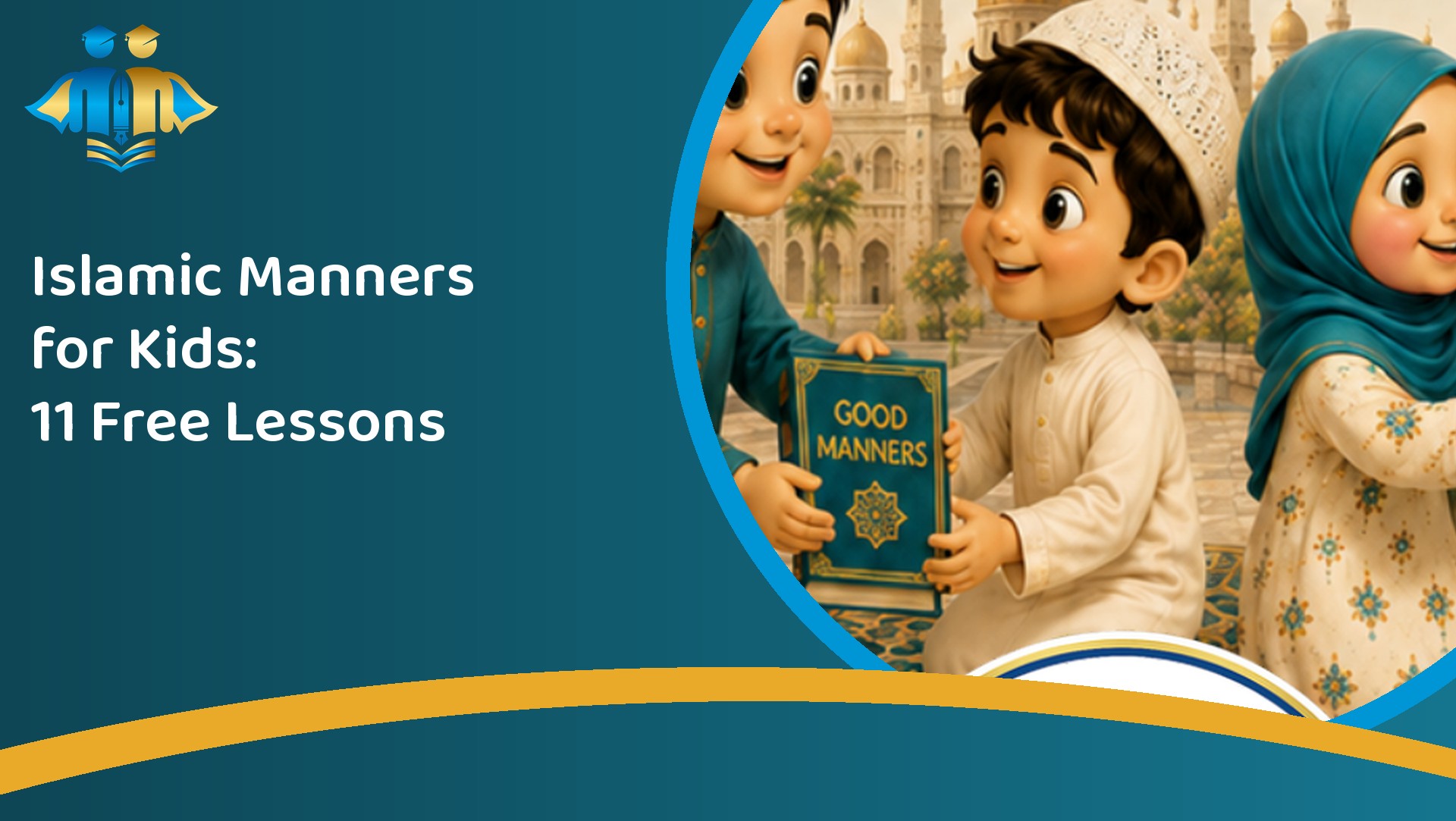
Islamic Manners for Kids: 11 Free Lessons with Stories and Printables
The short answer: Islamic manners (akhlaq) are easiest to teach one habit at a time. Each lesson below takes one manner, ties it to a Qur’an verse or hadith, tells a short story a child can picture, and ends with a 7-day checklist your child fills in at home. Work through one lesson a week and in under three months your child has practised eleven core Islamic manners.
This page brings together the full My Akhlaq Journey, Level 1 series, the same curriculum our teachers use in one-on-one classes. Every lesson is free, with printable pages.
Why akhlaq matters so much in Islam
The Prophet ﷺ said that among the best of people are those with the best character (Sahih al-Bukhari). Good manners aren’t an extra on top of the faith. They’re part of it. For children, that’s actually good news: you don’t need to explain theology to a five year old to start. Kindness, honesty and gratitude are things they can do today.
How each lesson works
- Warm-up questions to get your child talking.
- A short story with a character their age making a good choice.
- A Qur’an verse or hadith, in Arabic with transliteration and meaning.
- An activity: spot the good actions and the ones that need fixing.
- A 7-day checklist with five small habits and a star at the end of the week.
Unit 1: Good manners at home
- Lesson 1: Respecting parents. Verse: “Be good and kind to your parents” (17:23). Story: Sami helps his mother with the groceries.
- Lesson 2: Helping at home. Hadith: “The best of you are those who are best to their families” (Tirmidhi). Story: Mariam tidies the living room.
- Lesson 3: Kindness to brothers and sisters. Verse: “Speak kindly to people” (2:83). Story: Amina shares her blocks.
Unit 2: Good manners with others
- Lesson 4: Saying please and thank you. Hadith: “Whoever does not thank people does not thank Allah” (Tirmidhi).
- Lesson 5: Speaking kindly. Hadith: “Speak good or stay silent” (Bukhari and Muslim).
- Lesson 6: Sharing with friends. Hadith: “None of you truly believes until he loves for his brother what he loves for himself” (Bukhari and Muslim).
Unit 3: Beautiful Muslim character
- Lesson 7: Telling the truth. Hadith: “Truth leads to righteousness, and righteousness leads to Jannah” (Bukhari and Muslim).
- Lesson 8: Trustworthiness (amanah). Verse: “Allah commands you to return trusts to their owners” (4:58).
- Lesson 9: Keeping promises. Verse: “Fulfill every promise, for every promise will be asked about” (17:34).
Unit 4: Everyday Sunnah manners
- Lesson 10: Smiling is Sunnah. Hadith: “Your smile in the face of your brother is charity” (Tirmidhi).
- Lesson 11: Thanking Allah. Verse: “If you are grateful, I will surely give you more” (14:7).
Free printable: My Good Deeds Tracker
Alongside each lesson’s checklist, this tracker lets your child colour in a star every day they practise a good manner, across the whole series. It works well on the fridge or in a weekend Islamic school classroom.

Tips for teaching Islamic manners at home
One manner a week is enough. Trying to fix everything at once makes kids tune out. A focused week with one checklist works far better.
Teach on calm days. If the lesson only comes up after bad behaviour, it starts to feel like a punishment.
Notice out loud. “I saw you share your pencils today” does more than any reminder.
Model it. Children copy how we speak, thank, apologise and keep promises. Every lesson in this series is as much for parents as for kids.
Want a teacher to guide your child?
In our one-on-one Zoom classes, an Al-Azhar trained teacher takes your child through the whole series at their pace, explains each verse and hadith at their level, and follows up on every weekly challenge. Many families pair it with Quran or Arabic lessons.
Looking for an online Islamic school for kids? Our one-on-one Zoom classes teach akhlaq alongside the Quran, with online Quran classes for kids and Arabic for kids, all led by Al-Azhar trained teachers.
Frequently asked questions
What is akhlaq in Islam?
Akhlaq means character and manners: how a Muslim treats parents, family, friends and everyone else. It covers honesty, kindness, gratitude, keeping promises and more, and the Prophet ﷺ described good character as one of the best qualities a person can have.
What age should children start learning Islamic manners?
As soon as they can follow a short story, usually around 4 or 5. This Level 1 series is written for roughly 5 to 10 year olds.
In what order should I teach the lessons?
The series starts at home (parents, chores, siblings), moves to manners with others, then character traits like honesty and promises, and ends with everyday Sunnahs. Following that order works well, but each lesson also stands on its own.
Are the printables free?
Yes. Every lesson has a free printable checklist, and the good deeds tracker above is free too.

You may also like
How to Teach Kids Gratitude in Islam (A 7-Day Lesson)
Teaching Kids That Smiling Is Sunnah: A 7-Day Lesson