How to Teach Kids to Respect Parents in Islam (A 7-Day Lesson)
The short answer: kids learn to respect their parents in Islam the same way they learn anything else. You give them one clear reason from the Qur’an, one story they can picture, and one small thing to practice every day for a week. Lectures don’t stick. Checklists on the fridge do.
This is exactly how Lesson 1 of our My Akhlaq Journey curriculum is built, and below you’ll find the whole lesson: the verse, the story, the activity, and the printable checklist we use with our students. You can run it at home this week.
Why respecting parents comes first in Islamic manners
When Allah tells us how to treat our parents, He puts it right after the command to worship Him alone:
وَقَضَىٰ رَبُّكَ أَلَّا تَعْبُدُوا إِلَّا إِيَّاهُ وَبِالْوَالِدَيْنِ إِحْسَانًا
“And your Lord has decreed that you worship none but Him, and that you be good and kind to your parents.” (Qur’an 17:23)
That placement is something even a young child can understand. You can tell them: “Allah put being kind to Mama and Baba right next to worshipping Him. That’s how important it is.”
The Prophet ﷺ made the same point in a way kids remember easily. A man asked him who deserves his best treatment the most. He said “your mother” three times, and then “your father” (Sahih al-Bukhari and Sahih Muslim). Children love the repetition in this one. Ask them to guess the answer before you tell them.
What respect looks like for a 5 to 10 year old
Respect is a big word. For a child it needs to turn into things they can actually do. In our lesson we boil it down to five:
- Kind words. No “ugh”, no shouting back. The Qur’an itself says not to say even “uff” to your parents (17:23).
- Listening the first time. Not the third.
- Helping at home without being asked every time.
- Smiling at your parents.
- Saying thank you, out loud, for something specific.
Five is enough. If you give a child fifteen rules about respect, they will remember none of them.
Step 1: Start with a question, not a rule
Before teaching anything, our teachers open with three warm-up questions. Try them at dinner:
- Who helps you every day?
- How can you make your parents happy?
- What kind words can you say to your parents?
You’ll be surprised by the answers. Some kids will list everything their mum does in a day and realise, out loud, how much that is. That moment does more than any explanation.
Step 2: Read a short story together
Children connect with a character before they connect with a principle. Our story is about Sami, who sees his mother carrying heavy grocery bags. He runs to help, carries a small bag, puts the food on the table and brings her a glass of water. She smiles and says “Jazak Allahu khayran, Sami!” and he feels happy, because helping his mother is a good deed.
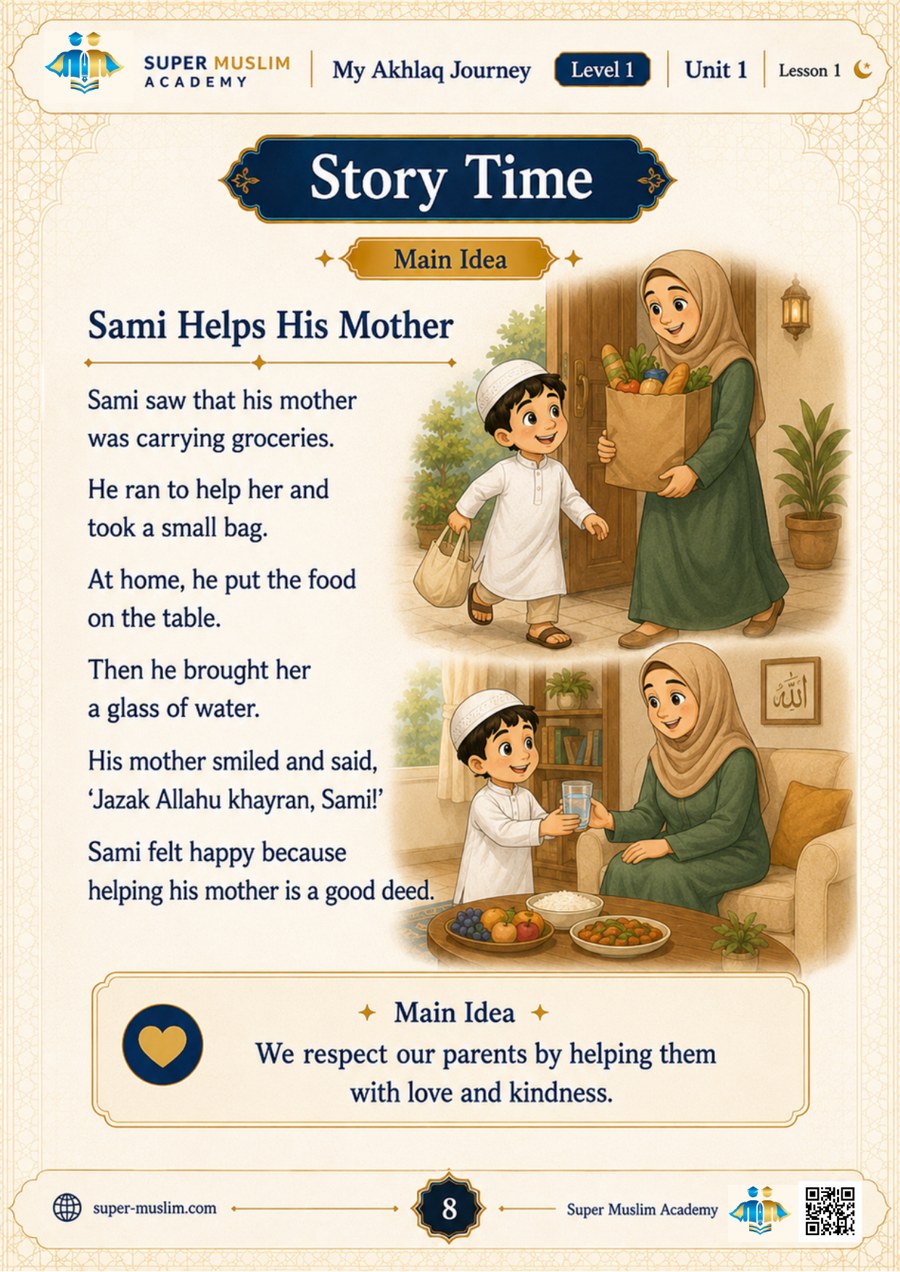
Notice what the story does not do. It doesn’t scold. Nobody in it misbehaves. It just shows a child doing the right thing and feeling good about it. After reading, ask: “What did Sami notice first?” The answer you’re looking for is that he noticed his mum needed help. That’s the real skill.
Step 3: Let them spot the kind actions
Next comes a quick activity. The child looks at four pictures and circles the kind ones: helping Mom carry bags, saying thank you. Then they spot the ones that aren’t: ignoring Dad when he calls, shouting at parents. There’s also a bonus box where they draw one way they help at home.
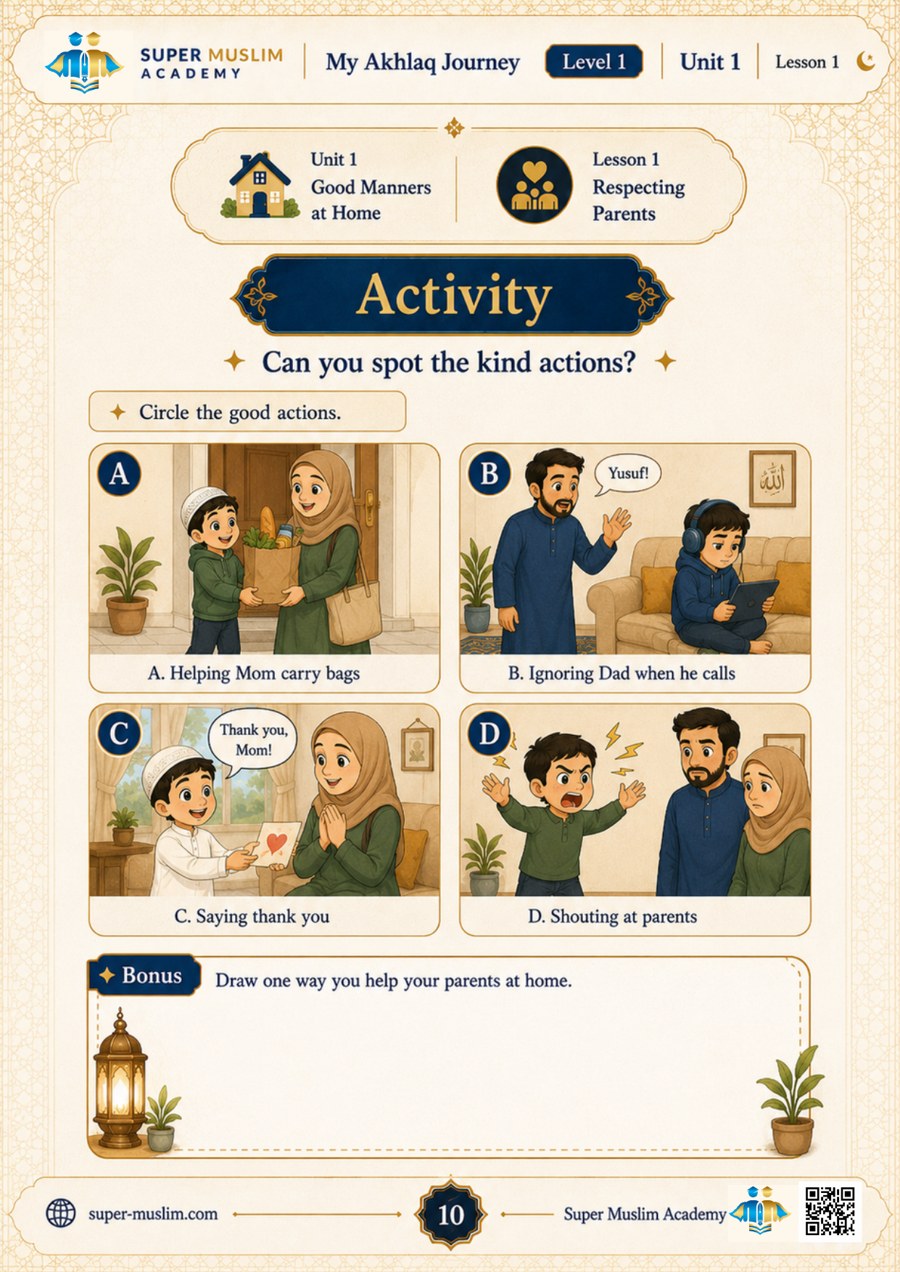
It sounds simple, and it is. But kids pay more attention to “find the wrong one” than to “here is the right one”. Let them be the judge.
Step 4: The 7-day respect challenge (free printable)
This is the part that changes behaviour. The child gets a checklist with the five habits, and for one week they tick a box every time they do one. At the end of the week they earn their “Star of Respect”. There’s also a little promise line at the bottom: “Today I will help my parents by…”
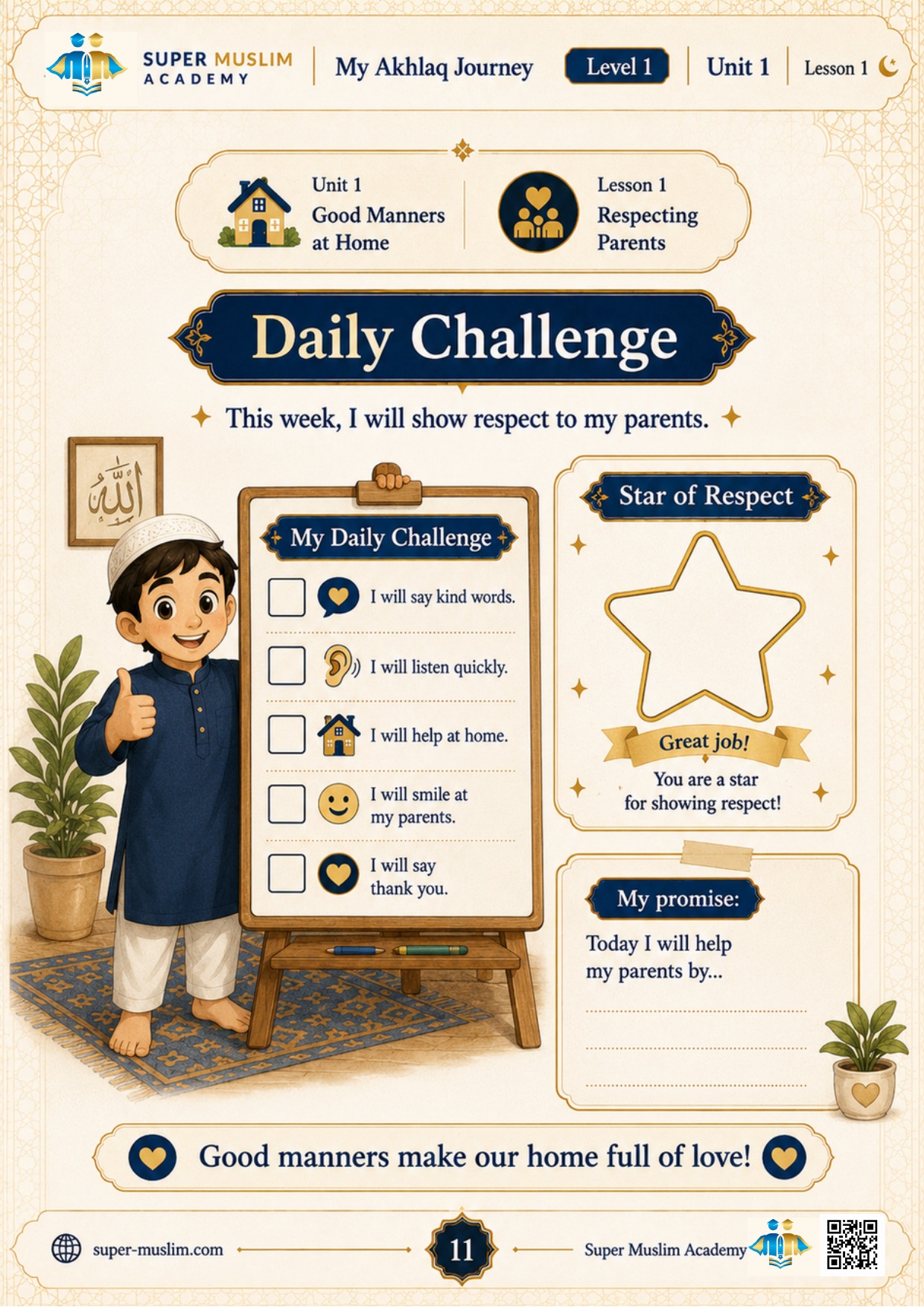
A few things that make the week work:
- Put the sheet somewhere visible. The fridge is perfect.
- Let the child tick the box, not you.
- Don’t punish a missed day. Just say “tomorrow is a new box”.
- Notice out loud when they do it without the sheet. “You listened the first time. I saw that.”
Step 5: End with a dua for parents
Right after the verse about kindness to parents, the Qur’an teaches a short dua that children can memorise in a few days:
رَّبِّ ارْحَمْهُمَا كَمَا رَبَّيَانِي صَغِيرًا
“My Lord, have mercy on them as they raised me when I was small.” (Qur’an 17:24)
Many families make it part of the bedtime routine. It also quietly teaches something the checklist can’t: that respecting parents is about gratitude, not just obedience.
Common mistakes parents make when teaching respect
Teaching it only when the child is being disrespectful. If the verse only comes up when they’ve just shouted at you, it starts to feel like a weapon. Teach it on a calm day.
Expecting it to last after one talk. Habits need repetition. That’s why the lesson is built around a full week, not a single conversation.
Forgetting that they’re watching us. Kids notice how we speak to our own parents on the phone. That lesson runs every day whether we plan it or not.
Want a teacher to take your child through the whole series?
Respecting Parents is the first of eleven lessons in My Akhlaq Journey, Level 1. The series moves on to helping at home, kindness to siblings, honesty, keeping promises, and more. In our one-on-one Zoom classes, a teacher reads the story with your child, explains the verse or hadith at their level, and checks in on the weekly challenge.
If you’re still deciding how to start, these might help: simple ways to teach Islam to kids at home, Islamic parenting tips for raising Quran-loving kids, and what to expect from a free trial class.
Looking for an online Islamic school for kids? Our one-on-one Zoom classes teach akhlaq alongside the Quran, with online Quran classes for kids led by Al-Azhar trained teachers.
Frequently asked questions
What does the Qur’an say about respecting parents?
Qur’an 17:23 commands kindness to parents right after the command to worship Allah alone, and forbids even saying “uff” to them. The next verse, 17:24, teaches the dua “Rabbi irhamhuma kama rabbayani saghira”.
At what age can I start teaching my child to respect parents in Islam?
As soon as they can follow a short story, usually around 4 or 5. Our Level 1 lesson is written for roughly 5 to 10 year olds, and younger children can do the checklist with help.
How do I teach respect without lecturing?
Use a story the child can picture, let them judge right and wrong actions themselves, and give them a small daily habit to practise for a week. Praise what you see them do, not what they promise.
Is the respect checklist free to print?
Yes. Open the checklist image above at full size and print it for your family or your weekend school class.

You may also like
How to Teach Kids to Share in Islam (A 7-Day Lesson)
How to Teach Kids to Speak Kindly in Islam (A 7-Day Lesson)