How to Teach Kids Trustworthiness (Amanah) in Islam: A 7-Day Lesson
The short answer: trustworthiness, or amanah, is about what a child does with things that aren’t theirs: a found toy, a borrowed book, a secret, a job they were given. You teach it with one verse, one story where a child chooses to give something back, and a week of small habits like returning what they find.
This is Lesson 8 of our My Akhlaq Journey curriculum. Lesson 7 covered telling the truth. This one goes a step further, from honest words to honest actions.
The verse: return trusts to their owners
إِنَّ اللَّهَ يَأْمُرُكُمْ أَن تُؤَدُّوا الْأَمَانَاتِ إِلَىٰ أَهْلِهَا
“Indeed, Allah commands you to return trusts to their owners.” (Qur’an 4:58)
For a young child, “trust” can sound abstract. Make it concrete: a trust is anything that belongs to someone else and is in your hands for a while. Your friend’s pencil. Your sister’s toy. The money Mama gave you for the shop. All of it has to go back.
It also helps to tell them that before the Prophet ﷺ received revelation, the people of Makkah already called him al-Amin, the trustworthy one. People who didn’t even follow him still left their valuables with him. That’s the kind of name a child can want for themselves.
Five trustworthiness habits
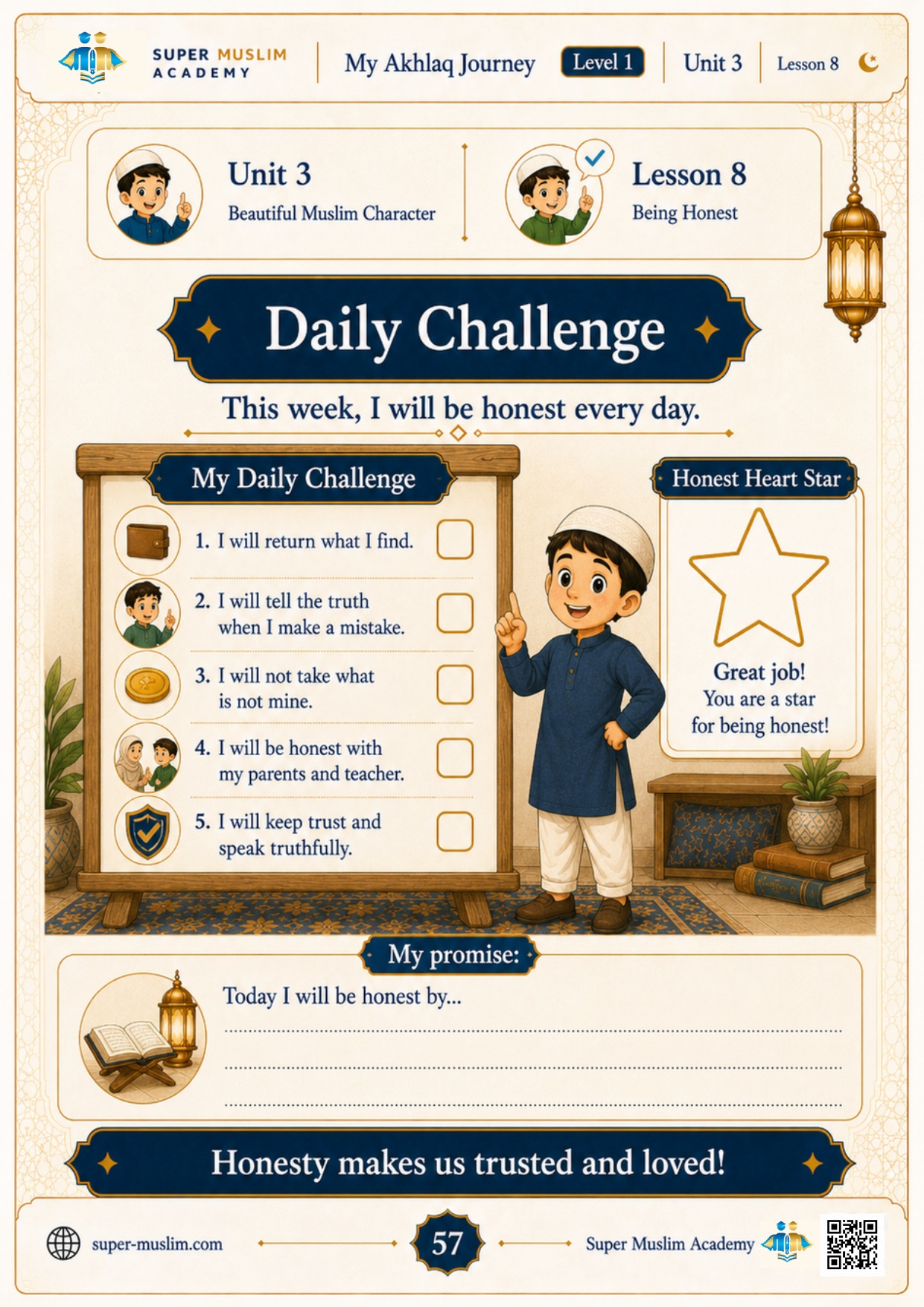
- Return what I find to its owner or a teacher.
- Tell the truth when I make a mistake.
- Don’t take what isn’t mine, even small things.
- Be honest with my parents and teacher.
- Keep trusts and speak truthfully.
Step 1: Warm-up questions
- What does it mean to be honest?
- Why should we return what belongs to others?
- How do people feel when we are honest?
Try asking your child how they’d feel if they lost their favourite toy and someone kept it. The answer to question two usually comes out on its own after that.
Step 2: Read the story of Hasan and the pencil box
Hasan finds a pencil box on the classroom floor. It’s bright blue and full of colours, and he wants to keep it. Then he remembers that honesty is good, picks it up and gives it to his teacher. Soon Salim comes looking for his pencil box, the teacher gives it back, and Salim says, “Thank you, Hasan!” Hasan feels happy because he chose honesty.
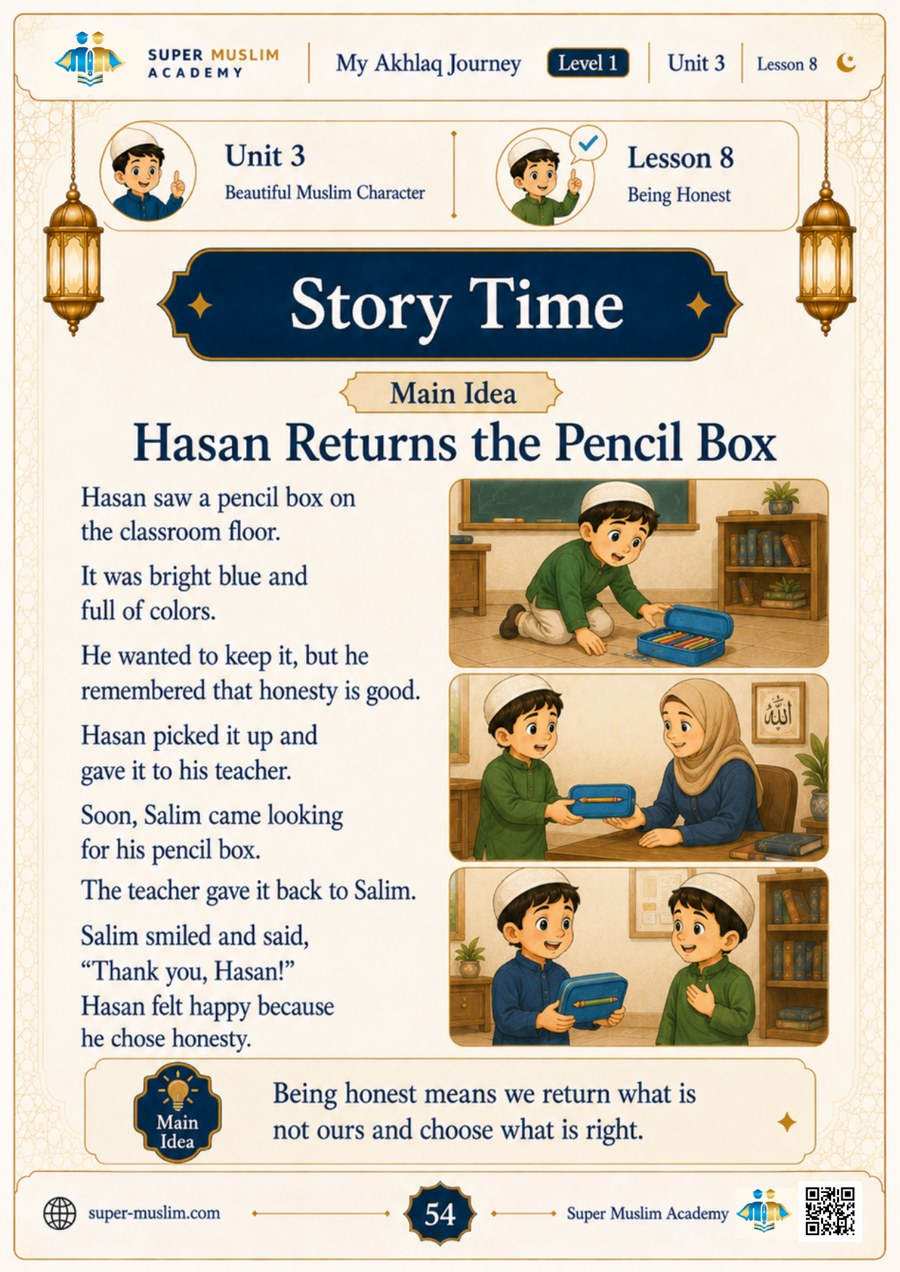
The honest moment in this story is “he wanted to keep it”. Don’t skip past it. Ask your child: “Have you ever found something you wanted to keep?” Most will say yes. That’s normal. The lesson is what you do next.
Step 3: Find the honest actions
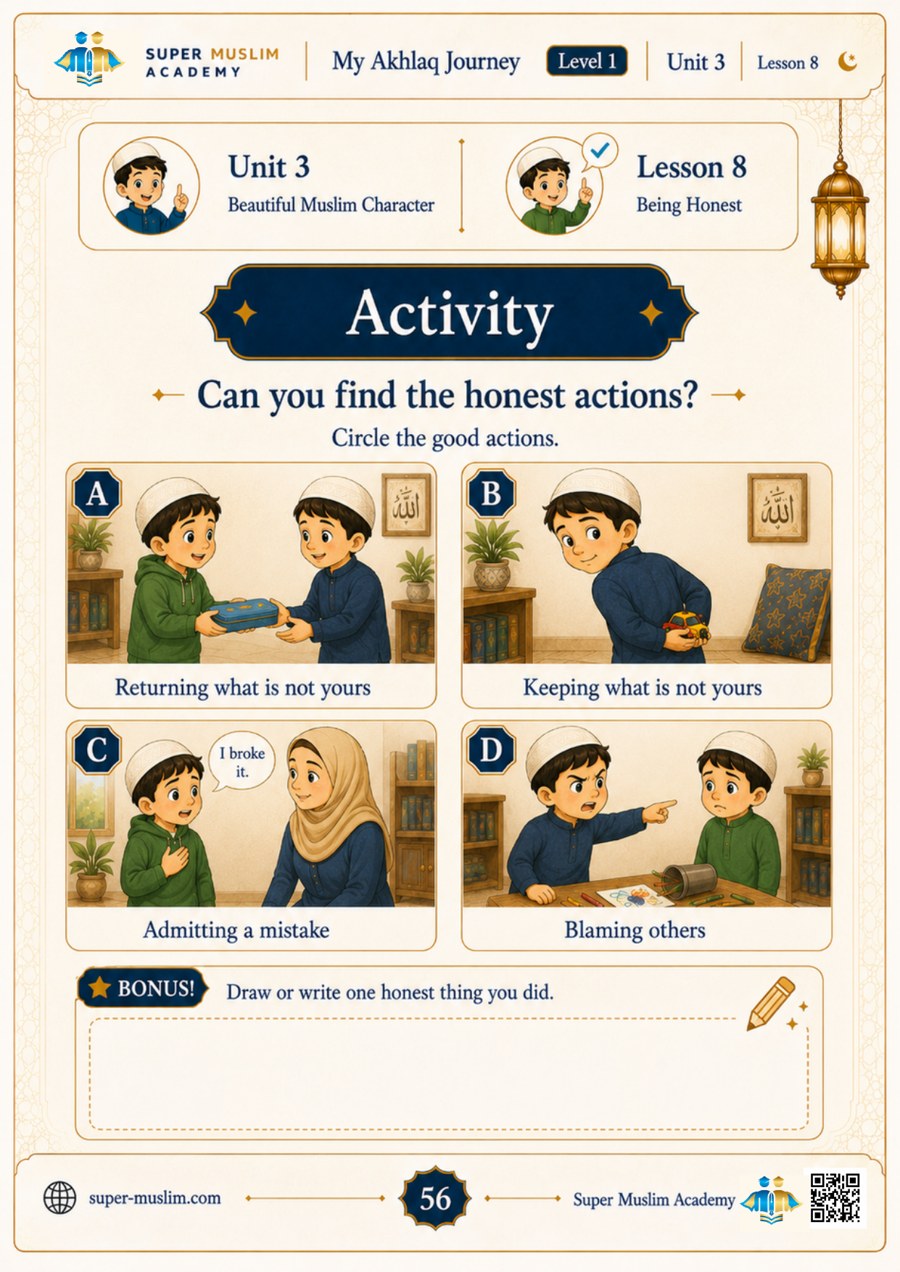
Four scenes: returning what’s not yours, keeping what’s not yours, admitting a mistake and blaming others. Your child circles the honest ones, then draws or writes one time they told the truth.
Step 4: The 7-day trustworthiness challenge (free printable)
Five habits, one box each per day, and an “Honest Heart Star” at the end of the week.
Making amanah real at home
Give them small trusts on purpose. Ask them to look after something for you for a day: your keys, a library book, the shopping list. Then thank them properly when they hand it back.
Keep a “found box”. Anything found around the house goes in the box until the owner claims it. It turns returning things into a routine instead of a lecture.
Model it in front of them. If a cashier gives you too much change, let your child see you hand it back. That one moment teaches more than the whole lesson.
Learn the whole series with a teacher
Being Honest is one of eleven lessons in My Akhlaq Journey, Level 1. Our teachers go through the story and the verse with your child one on one over Zoom and follow up on the weekly challenge.
More from the series: telling the truth, sharing with friends, respecting parents and kindness to siblings.
Looking for an online Islamic school for kids? Our one-on-one Zoom classes teach akhlaq alongside the Quran, with online Quran classes for kids led by Al-Azhar trained teachers.
Frequently asked questions
What is amanah in Islam for kids?
Amanah means trust: anything that belongs to someone else and is in your care. Allah commands us to return trusts to their owners (Qur’an 4:58). For a child that means returning found or borrowed things and not taking what isn’t theirs.
What should I do if my child takes something that isn’t theirs?
Stay calm, help them return it themselves, and praise the returning more than you scold the taking. The goal is for giving it back to feel like the natural next step.
Is the checklist free to print?
Yes. Open it above at full size and print it.

You may also like
Teaching Kids That Smiling Is Sunnah: A 7-Day Lesson
How to Teach Kids to Keep Promises in Islam (A 7-Day Lesson)