How to Teach Kids Honesty in Islam (A 7-Day Lesson)
The short answer: children tell the truth when it feels safe to. If owning up to a mistake always leads to anger, they learn to hide mistakes. Islam teaches that honesty leads to good and good leads to Jannah. Pair that with a calm reaction at home, a simple story and a week of small honesty habits, and truth starts to feel like the easy option.
This is Lesson 7 of our My Akhlaq Journey curriculum and the first lesson of Unit 3, “Beautiful Muslim Character”. It follows Lesson 6 on sharing with friends.
The hadith: truth leads to Jannah
إِنَّ الصِّدْقَ يَهْدِي إِلَى الْبِرِّ وَإِنَّ الْبِرَّ يَهْدِي إِلَى الْجَنَّةِ
“Truth leads to righteousness, and righteousness leads to Jannah.” (Sahih al-Bukhari and Sahih Muslim)
Kids like this hadith because it’s a path: truth, then good, then Jannah. You can draw it as three steps on a piece of paper. Each time they tell the truth, even about something small, they’ve taken a step.
It’s also worth sharing that before he received revelation, the Prophet ﷺ was already known in Makkah as al-Sadiq al-Amin, the truthful and trustworthy. Children love the idea that honesty can become part of your name.
Five honesty habits
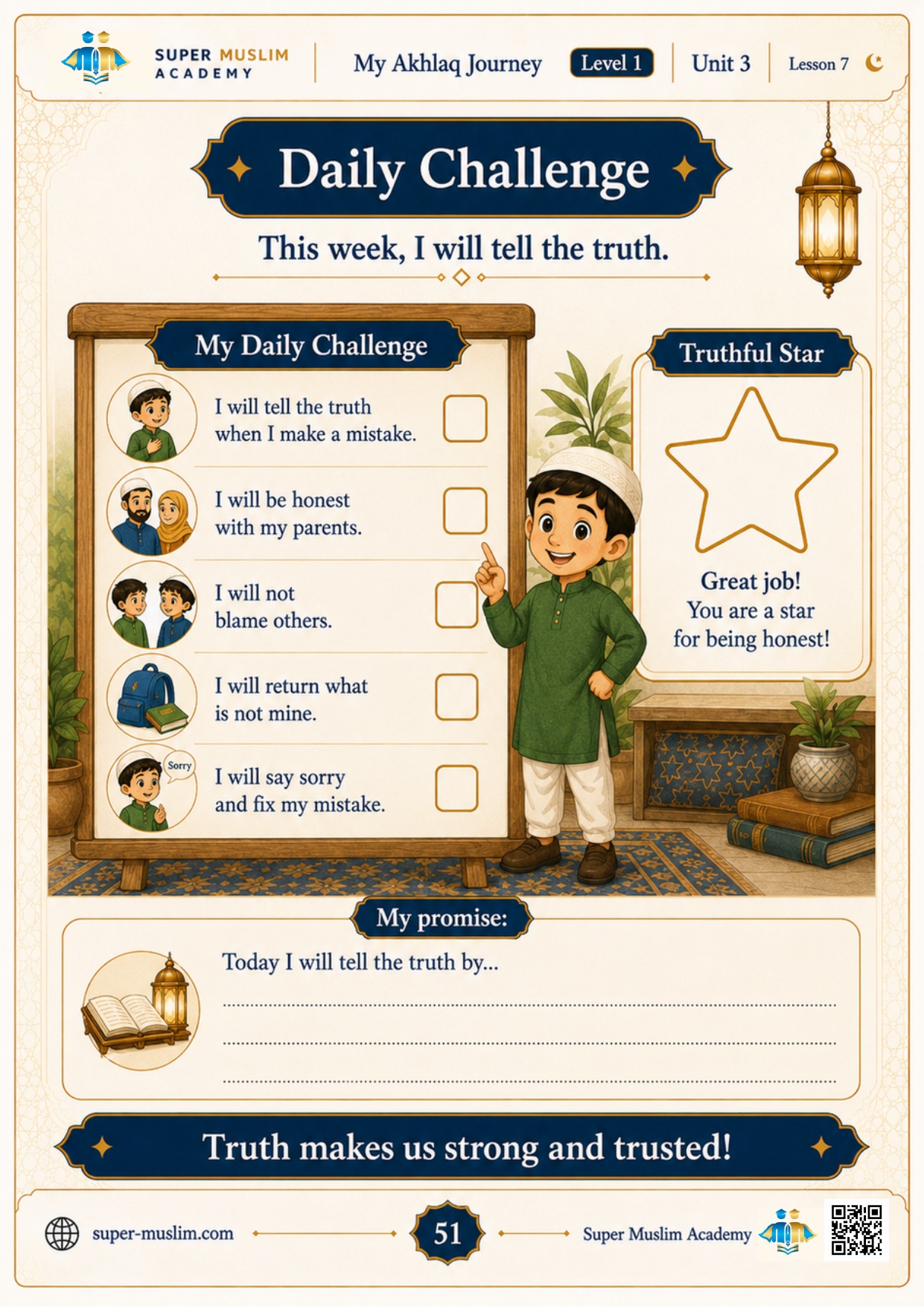
- Tell the truth when I make a mistake.
- Be honest with my parents.
- Don’t blame others.
- Return what isn’t mine.
- Say sorry and fix my mistake.
Step 1: Warm-up questions
- How do you feel when you tell the truth?
- Why is it brave to tell the truth?
- What can happen if we don’t tell the truth?
The word “brave” matters. Kids don’t usually think of honesty as courage, but it is. Saying “I broke it” takes more nerve than hiding it, and it helps them to hear a grown-up say so.
Step 2: Read the story of Yusuf and the spilled juice
Yusuf is playing with his little sister at home. While running, he knocks over a cup and the juice spills on the floor. He feels worried. Then he goes to his mother and says, “I spilled the juice. I am sorry.” His mother smiles and says, “Thank you for telling the truth. Let’s clean it together.” Yusuf feels calm and happy inside.
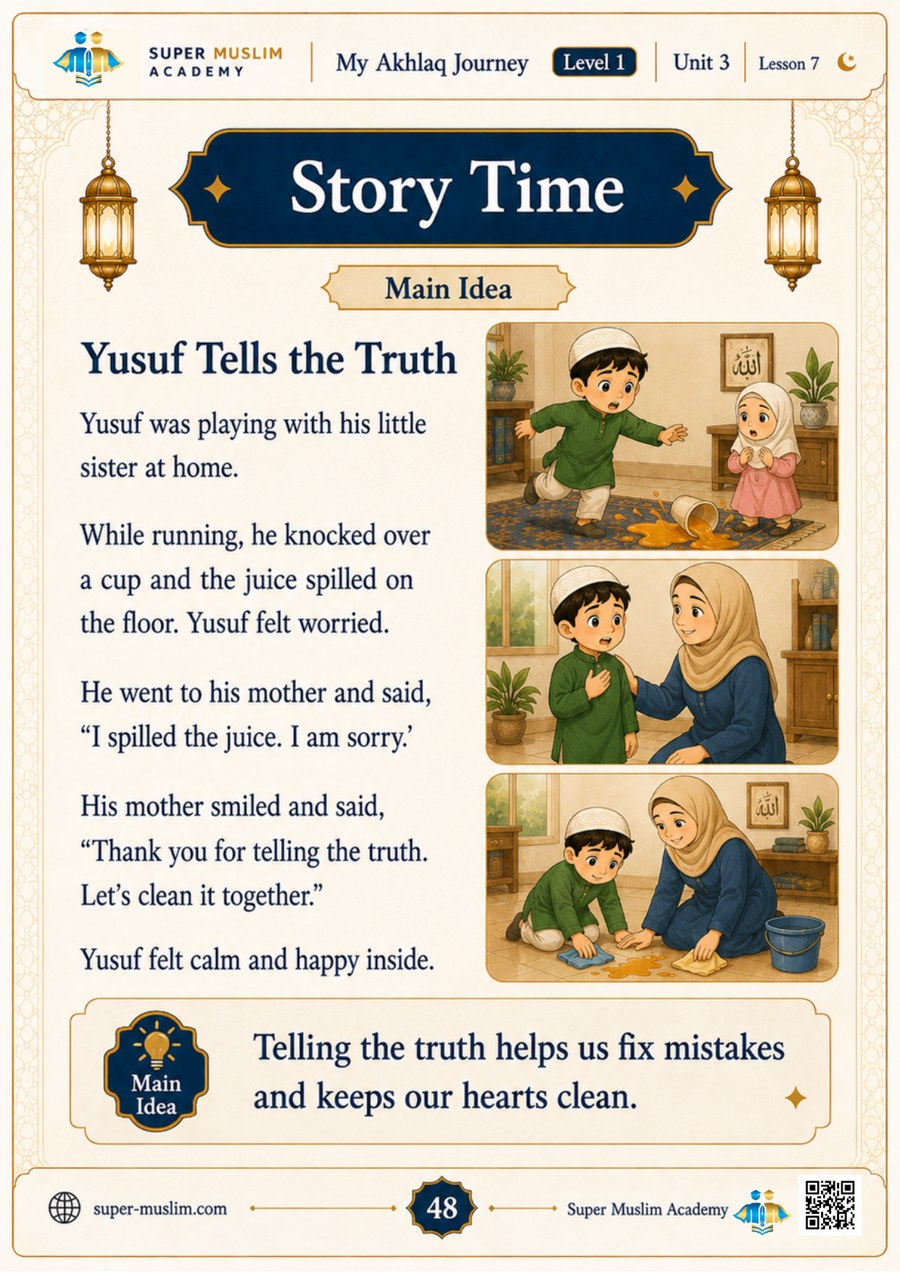
This story is honestly as much for parents as it is for children. Look at the mother’s reaction. She thanks him first and solves the problem with him second. That’s the reaction that makes the next confession easier.
Step 3: Find the truthful actions
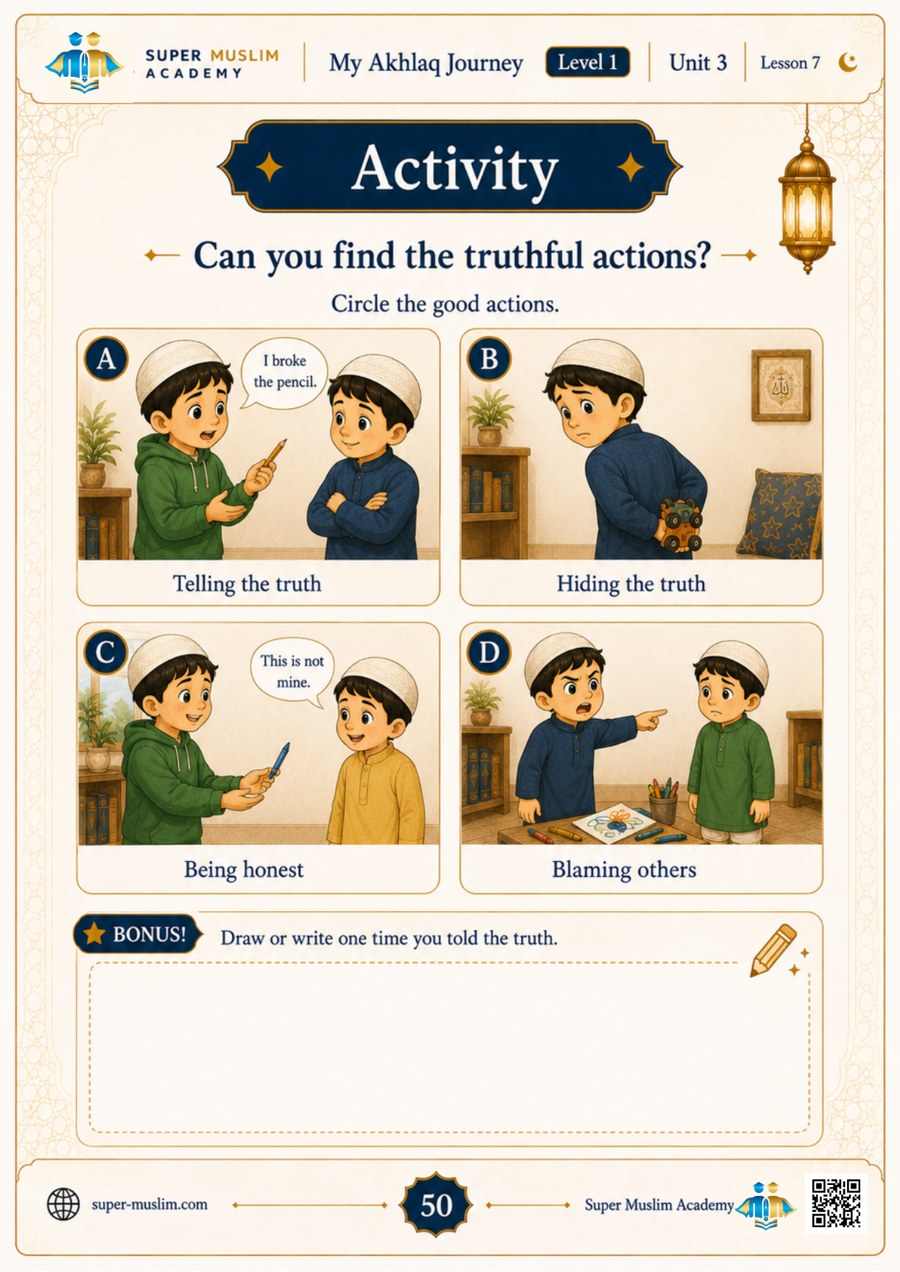
Four scenes: telling the truth, hiding the truth, being honest and blaming others. Ask your child which one is the hardest to do. Then ask which one feels best afterwards.
Step 4: The 7-day honesty challenge (free printable)
Your child ticks a box for each honest moment and earns the “Truthful Star” at the end of the week.
Making honesty feel safe at home
Separate the truth from the mistake. “Thank you for telling me” first, then deal with the broken thing. If the reward for honesty is the same punishment as getting caught, kids notice.
Don’t set traps. Asking “Did you eat the biscuits?” when you already know invites a lie. “I see the biscuits are gone, let’s talk about it” gives them room to be honest.
Admit your own mistakes. “I was wrong to shout earlier, I’m sorry” is one of the most powerful things a child can hear from a parent.
Learn the whole series with a teacher
Telling the Truth is one of eleven lessons in My Akhlaq Journey, Level 1. Our teachers go through the story and hadith with your child one on one over Zoom and follow up on the weekly challenge.
More from the series: respecting parents, helping at home, speaking kindly and sharing with friends.
Looking for an online Islamic school for kids? Our one-on-one Zoom classes teach akhlaq alongside the Quran, with online Quran classes for kids led by Al-Azhar trained teachers.
Frequently asked questions
What does Islam say about honesty?
The Prophet ﷺ said, “Truth leads to righteousness, and righteousness leads to Jannah” (Bukhari and Muslim). He was known as al-Sadiq al-Amin, the truthful and trustworthy, even before prophethood.
How do I stop my child lying?
Make honesty safe: thank them for telling the truth before dealing with the mistake, avoid asking questions you already know the answer to, and model admitting your own mistakes.
Is the checklist free to print?
Yes. Open it above at full size and print it.

You may also like
Islamic Eating Manners for Kids: 5 Sunnah Table Habits (Free Printable)