Sun and Moon Letters in Arabic: Rules and Examples
Sun and moon letters are an essential part of learning Arabic pronunciation and reading the Quran correctly. They explain why the Arabic letter ل (Lam) is sometimes pronounced clearly after the definite article ال (Al) and sometimes assimilated into the following letter. Understanding this rule helps beginners recognize Arabic words, improve their pronunciation, and develop better Quran recitation skills.
Although the rule may seem difficult at first, it becomes easier with simple examples and regular practice. In this guide, we will explain the differences, list the letters, and show how learners can apply the rule when reading Arabic and the Quran.
What Are Sun and Moon Letters in Arabic?
In Arabic, the definite article ال (Al) is used to make a noun definite, similar to the word “the” in English. However, the pronunciation of the letter Lam changes depending on the first letter of the word that follows it.
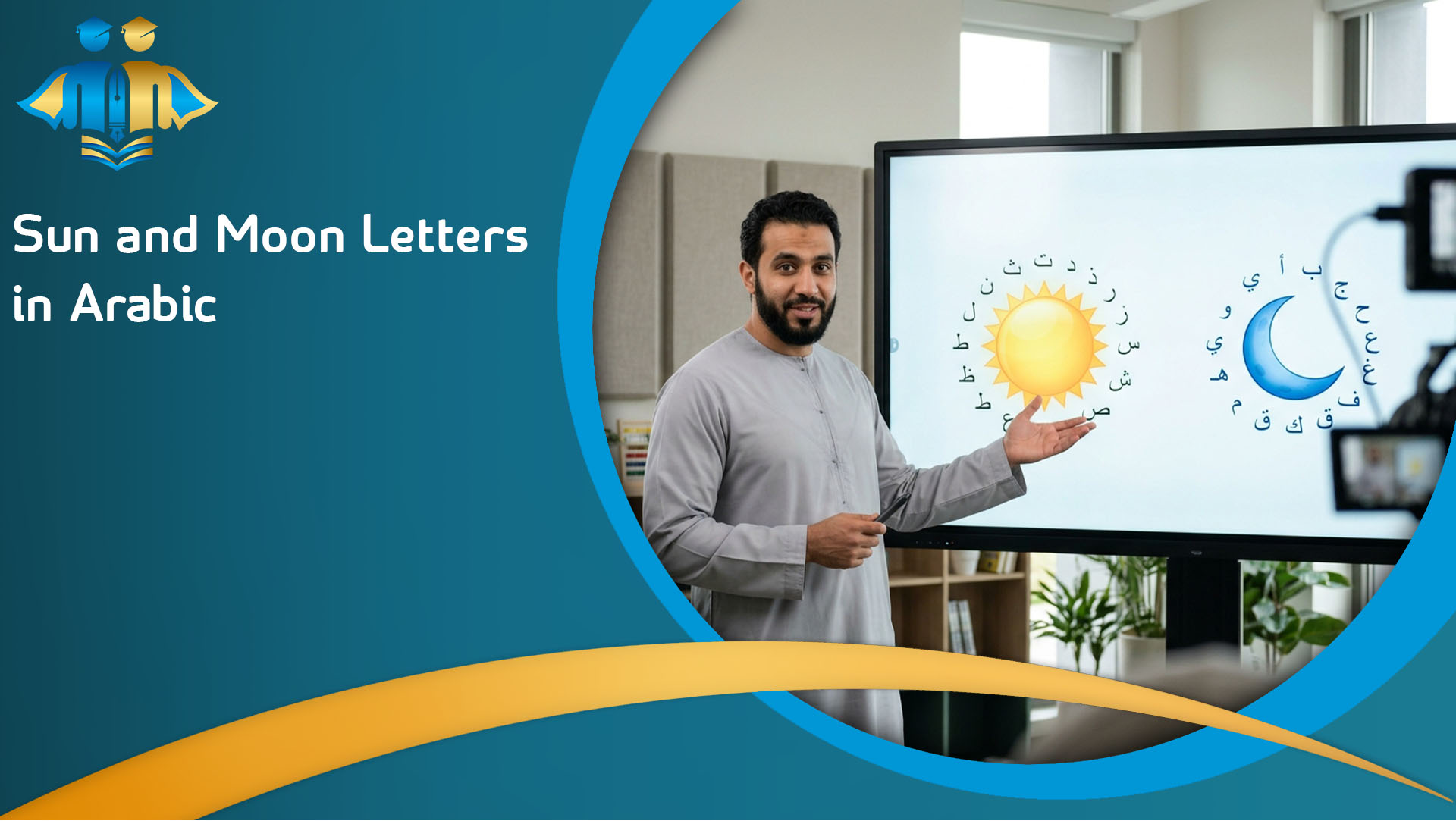
Arabic letters are divided into two groups: sun letters and moon letters.
With sun letters, the Lam in ال is not pronounced. Instead, the following letter is pronounced with emphasis (Shaddah). With moon letters, the Lam is pronounced clearly without assimilation. These examples demonstrate the basic distinction between the two groups.
For example:
- الشَّمْسُ (Ash-Shams): The Lam is not pronounced, and the letter Sheen is emphasized.
- الْقَمَرُ (Al-Qamar): The Lam is pronounced clearly before the letter Qaf.
What Are the 14 Sun Letters?
The Arabic alphabet contains 14 consonants. When one of these letters comes after the definite article ال, the Lam becomes assimilated into the following letter. The 14 sun letters are
ت، ث، د، ذ، ر، ز، س، ش، ص، ض، ط، ظ، ل، ن
Some common examples include:
| Arabic Word | Pronunciation | Meaning |
|---|---|---|
| الشَّمْس | Ash-Shams | The sun |
| التِّين | At-Teen | The fig |
| الرَّحْمَن | Ar-Rahman | The Most Merciful |
| النَّاس | An-Naas | The people |
| السَّمَاء | As-Samaa | The sky |
| الصَّبْر | As-Sabr | Patience |
| الدِّين | Ad-Deen | The religion |
Notice that the “lam” is written in these words but is not pronounced. Instead, the following letter carries a Shaddah, indicating a doubled or emphasized sound.
What Are the 14 Moon Letters?
Moon letters are the other 14 letters of the Arabic alphabet. When a word begins with one of these letters after ال, the Lam is pronounced clearly. The 14 moon letters are
ا، ب، ج، ح، خ، ع، غ، ف، ق، ك، م، هـ، و، ي
Here are some examples:
| Arabic Word | Pronunciation | Meaning |
|---|---|---|
| الْقَمَر | Al-Qamar | The moon |
| الْكِتَاب | Al-Kitab | The book |
| الْبَيْت | Al-Bayt | The house |
| الْمَسْجِد | Al-Masjid | The mosque |
| الْحَمْد | Al-Hamd | Praise |
| الْعِلْم | Al-Ilm | Knowledge |
| الْوَلَد | Al-Walad | The boy |
In these examples, the Lam is clearly heard when pronouncing the word. There is no assimilation into the following letter.
What Is the Difference Between Sun and Moon Letters?
The main difference between sun and moon letters is how the Lam in the definite article ال is pronounced.
| Feature | Sun Letters | Moon Letters |
|---|---|---|
| Number of letters | 14 | 14 |
| Lam pronunciation | Silent | Clearly pronounced |
| Shaddah | On the following letter | Not added because of this rule |
| Example | الشَّمْس | الْقَمَر |
| Pronunciation | Ash-Shams | Al-Qamar |
One useful way to recognize the difference is to look for the Shaddah. With sun letters, the following letter usually carries a Shaddah. With moon letters, the Lam remains clearly pronounced.
Learning this distinction is an important step for anyone following a structured Arabic reading program, especially beginners who are starting to learn Noorani Qaida in English.
Why Are Sun and Moon Letters Important in Quran Recitation?
Learning the correct pronunciation of Arabic letters is essential for reading the Quran accurately. The rules of the definite article help learners avoid common pronunciation mistakes and recognize how connected Arabic words should sound.
For example, when reading Surah Ash-Shams, the word الشَّمْس is pronounced Ash-Shams rather than Al-Shams. Similarly, الْقَمَر in Surah Al-Qamar is pronounced Al-Qamar, with a clearly audible Lam.
Moreover, understanding these rules supports the development of broader Arabic Speaking Classes reading skills. Learners who recognize letter patterns can read unfamiliar words more confidently and gradually improve their fluency.
It is also helpful to understand related pronunciation topics, such as sukoon and jazm, because Arabic reading depends on recognizing different vowel and pronunciation signs.
How Can Beginners Memorize Sun and Moon Letters?
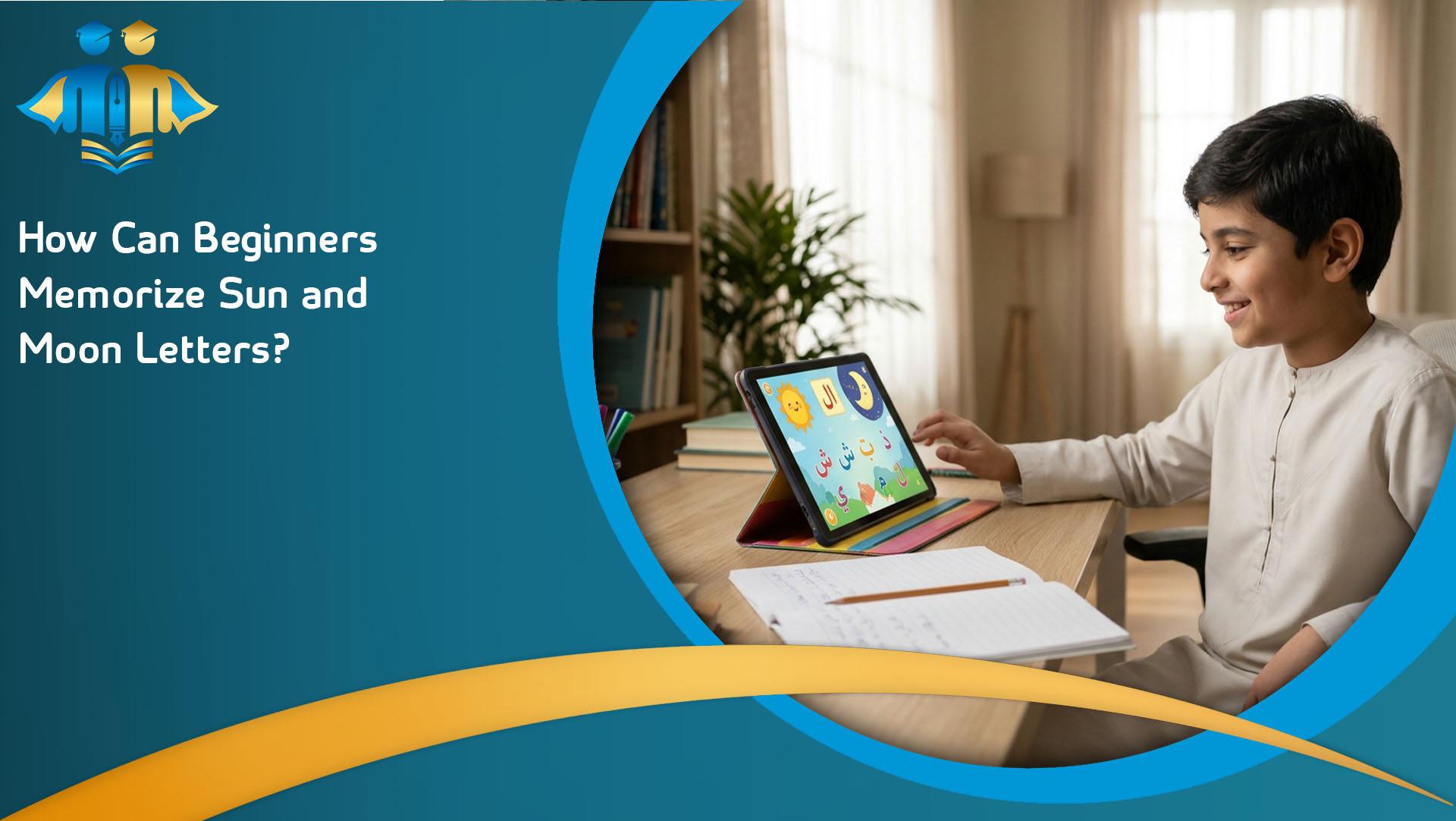
Memorizing the two groups becomes easier when learners combine repetition, listening, and practical reading exercises. Here are five useful methods:
- Divide the letters into two groups: Write the 14 sun letters and 14 moon letters separately, then review them regularly.
- Practice with familiar words: Start with simple examples such as الشَّمْس and الْقَمَر before moving to longer words.
- Listen to correct pronunciation: Listen to a qualified Arabic or Quran teacher and repeat each word carefully.
- Read Quranic examples: Find words containing the definite article in short Surahs and identify their pronunciation.
- Test your understanding: Ask someone to give you Arabic words and decide whether the Lam should be pronounced or assimilated.
Consistent practice is more effective than memorizing the letter lists once and forgetting them. Beginners can also strengthen their general Arabic vocabulary through lessons such as how to learn Arabic for kids.
Learn Arabic Pronunciation with Super Muslim Online Quran Academy.
Learning Arabic pronunciation can be easier when students receive structured instruction and regular feedback. Super Muslim Online Quran Academy provides an opportunity for learners to develop their Quran reading and Arabic skills through online learning.
With guidance from a qualified teacher, students can practice recognizing Arabic speech, understanding pronunciation rules, and applying them while reading Quranic verses.
In addition, learners can work on related Islamic topics and develop a stronger understanding of their religious education, including subjects such as what is taqwa in Islam.
The important thing is to follow a suitable learning pace, ask questions when a rule is unclear, and practice regularly instead of rushing through the lessons.
Frequently Asked Questions About Sun and Moon Letters
Find clear answers to common questions about sun and moon letters, their pronunciation rules, examples, and importance in Arabic reading and Quran recitation.
1. How many sun and moon letters are there in Arabic?
There are 28 Arabic letters in total. Fourteen are classified as sun letters, while the remaining fourteen are moon letters.
2. Why are they called sun and moon letters?
The names come from two familiar Arabic words: Ash-Shams (the sun) and Al-Qamar (the moon). The first demonstrates Lam assimilation, while the second demonstrates clear Lam pronunciation.
3. Is the Lam written in sun letters?
Yes. The Lam is written as part of the definite article ال, but it is not pronounced when followed by a sun letter. Instead, the following letter is emphasized with a Shaddah.
4. Do beginners need to memorize both groups?
Yes. Memorizing the two groups helps beginners recognize pronunciation patterns, read Arabic words more accurately, and improve their Quran recitation over time.
Conclusion
Understanding the Arabic definite article is an important step toward improving Arabic reading and Quran recitation. Learning the difference between the sun and moon letters helps beginners pronounce words correctly and recognize when the “lam” is silent or clearly pronounced.
Through regular practice, listening to correct pronunciation, and reading Quranic examples, learners can gradually master this rule. Additionally, studying related topics such as Shaddah and Sukoon strengthens their Arabic reading skills.
With structured lessons and guidance from a qualified teacher at Super Muslim Online Quran Academy, students can build confidence, improve their pronunciation, and develop a stronger foundation for reading the Quran accurately.

You may also like

Learn Noorani Qaida in English: A Beginner’s Guide

Quran Learning for Non-Arabic Speakers: A Simple Guide