
Interactive Quran Learning Methods for Better Results
Interactive Quran learning methods help students move beyond passive listening and become active participants in their Quran education. These methods combine educational games, storytelling, guided discussions, digital activities, and practical exercises to make learning more engaging and meaningful.
Learning the Quran is an important goal for Muslim families, children, and adults. However, traditional teaching approaches often don’t give students enough opportunities to participate, ask questions, or practice independently. Busy schedules, different learning abilities, and limited access to suitable educational resources can also make consistent learning challenging.
Fortunately, modern educational approaches offer new ways to make Quran lessons more engaging. Interactive Quran Learning Methods combine teacher guidance with activities that encourage students to think, explore, practice, and apply what they learn. As a result, students can participate more actively instead of simply receiving information.
Whether a child is learning Arabic letters for the first time or an adult wants to improve Quran recitation, interactive activities can support different learning goals. The key is choosing suitable methods according to the learner’s age, experience, and educational needs.
In this guide, we will explore 15 practical interactive Quran learning methods, explain their benefits, and share useful strategies for teaching children and adults. We will also discuss how families and teachers can create an enjoyable learning environment through structured activities and consistent practice.
How Do Interactive Quran Learning Methods Work?
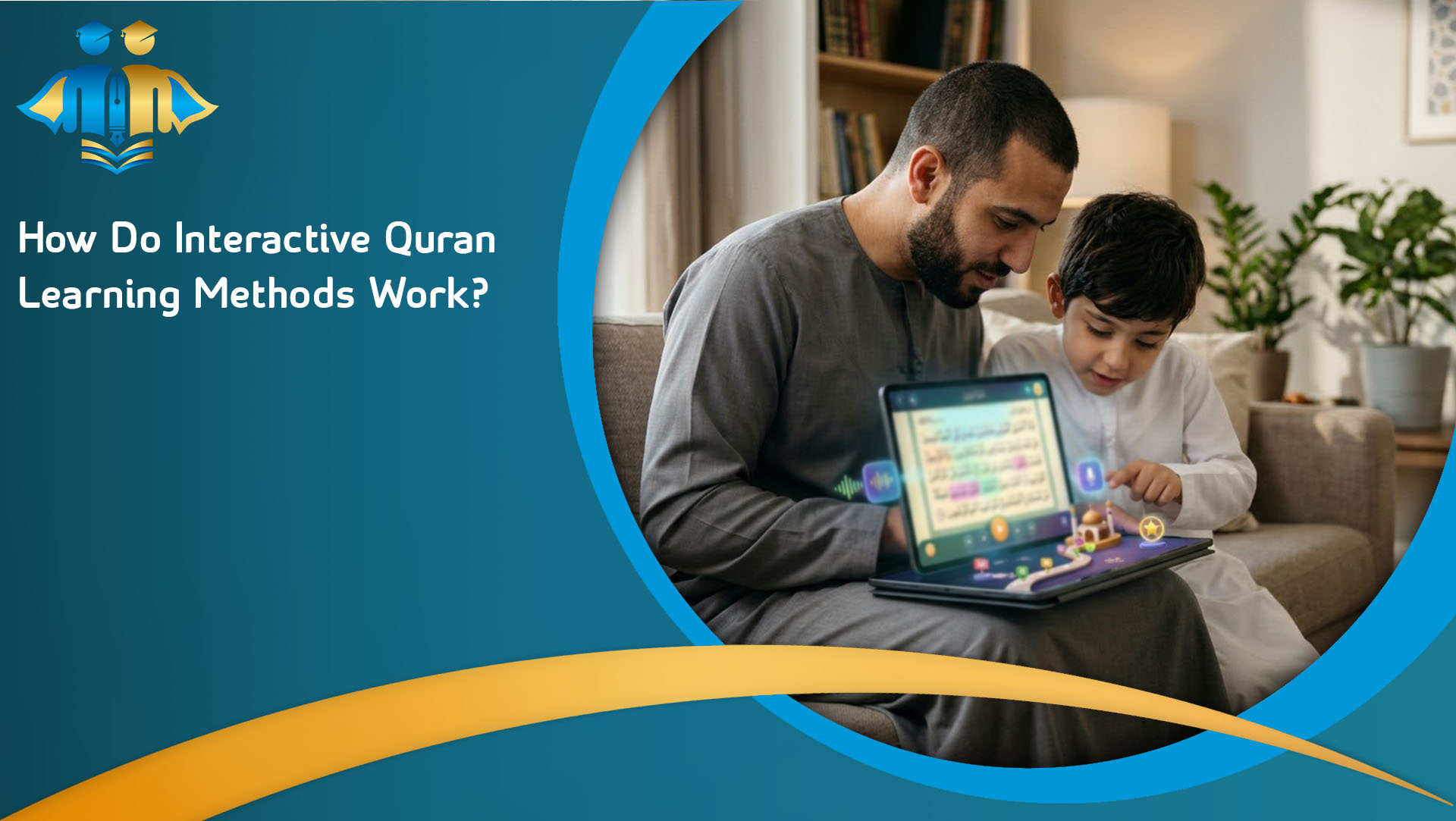
Interactive Quran learning methods are teaching approaches that encourage students to participate actively during Quran lessons. Instead of relying entirely on explanations from the teacher, these methods involve discussions, questions, educational games, practical exercises, and collaborative activities.
The main objective is to make Quran education a two-way learning experience. Teachers explain concepts, demonstrate correct recitation, and provide guidance, while students respond, practice, ask questions, and demonstrate their understanding.
For example, when teaching a new Surah, a teacher might combine several activities:
- Reading the verses together and identifying unfamiliar words.
- Asking students to explain the meaning of selected vocabulary.
- Practicing correct pronunciation through guided recitation.
- Using a short quiz to review the lesson.
- Discussing practical lessons that students can understand and apply.
These activities give learners different opportunities to engage with the material. Furthermore, interactive Quran learning methods can accommodate different learning preferences. Some students understand information more easily through visual examples, while others benefit from listening, speaking, repetition, or hands-on activities.
However, interactive teaching does not mean replacing traditional Quran instruction. Correct recitation, Tajweed principles, memorization, and teacher supervision remain essential. Instead, interactive activities complement these foundations by making the learning process more participatory.
Start Learning the Quran with Trusted Egyptian Teachers Today
Ready to improve your Quran recitation, master Tajweed, or begin memorizing the Holy Quran with confidence? At Super Muslim Online Quran Academy, our experienced Egyptian Quran teachers provide personalized one-on-one lessons tailored to your age, level, and goals.
Enjoy flexible scheduling, live guidance, and a supportive learning environment that helps you make steady progress from the comfort of your home. Book your free trial class today and take the first step toward a stronger connection with the Book of Allah.

15 Effective Interactive Quran Learning Methods for Students
There is no single teaching activity that works equally well for every learner. Therefore, teachers should combine different approaches and adjust them according to students’ abilities and learning objectives.
The following Interactive Quran Learning Methods provide practical ideas that can be incorporated into individual lessons, family learning sessions, and online Quran classes.
1. Interactive Quran Learning Methods Through Storytelling
Quranic storytelling is an effective way to introduce important events, personalities, and moral lessons. Rather than presenting historical information through lengthy explanations, teachers can encourage students to explore stories and reflect on their messages.
For instance, when discussing Prophet Ibrahim (peace be upon him), a teacher can explain his commitment to worshipping Allah and his rejection of idol worship.
Afterward, students can answer questions such as:
- What important lesson can we learn from this story?
- Why did Prophet Ibrahim remain committed to his beliefs?
- How can we demonstrate honesty and faith in our daily lives?
- Which Quranic verses mention this event?
Additionally, teachers can ask younger learners to arrange story events in the correct order or identify important characters.
This approach helps students connect Quranic narratives with meaningful discussions. Nevertheless, teachers should distinguish between authentic Quranic information and additional storytelling details that may not have reliable sources.
2. Using Technology in Interactive Quran Learning Methods
Technology provides several opportunities to make Quran education more accessible and engaging. Digital resources can support pronunciation practice, Arabic reading, memorization, and knowledge assessment.
For example, teachers can use educational applications, digital whiteboards, screen sharing, and interactive presentations during online lessons.
Some useful activities include:
- Digital Arabic letter recognition exercises.
- Interactive Tajweed quizzes.
- Listening exercises using recorded Quran recitation.
- Digital flashcards for Arabic vocabulary.
- Online memorization revision activities.
- Interactive presentations explaining selected Quranic concepts.
Furthermore, teachers can share learning materials through digital platforms so students can review lessons between classes.
However, technology should support the educational objective rather than distract students. A simple pronunciation exercise with immediate teacher feedback may be more valuable than a complicated application with unnecessary features.
When applying Interactive Quran Learning Methods through technology, teachers should also consider screen time, internet access, and the student’s ability to use digital tools independently.
3. Group Discussions About Quranic Verses
Group discussions encourage students to express their understanding and listen to different perspectives. They can also help learners develop confidence when discussing Quranic lessons.
For example, after studying a Surah, the teacher can divide students into small groups and assign each group a discussion topic.
Possible discussion questions include:
- What values are emphasized in the selected verses?
- What lessons can Muslims learn from these teachings?
- Which unfamiliar words require further explanation?
- How can the lessons influence everyday decisions?
After completing the discussion, each group can present its findings to the teacher and other students. Importantly, discussions about Quranic interpretation should remain guided by reliable Tafsir sources and qualified instruction. Students should not be encouraged to make unsupported interpretations of verses.
This method is particularly useful for learners who already have basic Quran knowledge and are ready to explore meanings more deeply.
4. Learning the Quran Through Educational Games
Educational games can make Quran lessons more enjoyable, especially for younger students. They introduce challenges and achievable goals while providing opportunities to review previously learned material. Teachers can choose games according to the lesson’s objective.
Examples of interactive Quran games:
| Game | How It Works | Learning Objective |
|---|---|---|
| True or False | Students decide whether a statement about a lesson is correct. | Reviewing knowledge |
| Missing Words | Students complete incomplete verses using an appropriate exercise. | Memorization practice |
| Word Matching | Learners match Arabic vocabulary with its meanings. | Vocabulary development |
| Spinning Wheel | A selected question appears when the wheel stops. | Lesson revision |
| Tajweed Challenge | Students identify a previously taught recitation rule. | Tajweed awareness |
For example, a teacher can display an Arabic word and ask students to identify its meaning or pronunciation.
Additionally, friendly competitions can motivate learners to participate. However, the objective should remain educational rather than simply determining who finishes first.
Teachers should ensure that exercises use Quranic text accurately and avoid turning Quran recitation into an inappropriate competitive activity.
5. Exploring Quranic Stories Through Creative Activities
Story-based activities offer another way to make Quran education memorable. Instead of limiting the lesson to reading and explanation, teachers can introduce age-appropriate creative exercises.
For instance, students can create a simple timeline illustrating important events from the story of Prophet Musa (peace be upon him). Other activities include:
- Drawing educational storyboards without depicting prophets.
- Arranging important events in chronological order.
- Creating vocabulary cards connected to the story.
- Identifying moral lessons from selected passages.
- Preparing short presentations about Quranic narratives.
Parents can also read appropriate Quranic stories with their children during family time. During Ramadan, families may establish a regular storytelling session that encourages children to explore Quranic teachings and ask questions.
These activities connect learning with curiosity. Moreover, they provide opportunities for parents to participate in their children’s educational development.
6. Role-Playing and Practical Learning Activities
Role-playing allows students to explore Islamic values through familiar situations. Teachers can present everyday scenarios and ask learners to consider how Quranic teachings guide appropriate behavior.
For example, a teacher might describe a situation in which a student finds something belonging to another person. Students can discuss:
- Why should the item be returned?
- Which Islamic values relate to this situation?
- How can honesty influence our decisions?
- What would be the appropriate response?
Another example involves preparing a situation about helping someone in need or showing kindness to family members. Through these activities, students can connect general moral principles with practical experiences.
Nevertheless, teachers should avoid reenacting prophets or presenting imagined historical events as authentic accounts. The purpose is to explore moral applications, not dramatize sacred narratives.
7. Using Visual Aids to Explain Quranic Concepts
Visual materials can help students understand information that might otherwise seem difficult or abstract. Teachers can introduce diagrams, educational charts, vocabulary cards, and illustrated learning materials according to the lesson.
For example, a chart can organize the basic categories of Tajweed rules and provide a short explanation of each category. Other useful visual resources include:
- Arabic alphabet charts for beginners.
- Diagrams showing the articulation points of Arabic letters.
- Tables comparing similar Arabic sounds.
- Mind maps connecting vocabulary with meanings.
- Visual schedules for memorization and revision.
When teaching children, colorful materials and simple illustrations can make activities easier to follow. However, visual aids should remain accurate and respectful of Quranic content. They should explain the lesson rather than replace listening to correct recitation and practicing with a qualified teacher.
8. Art and Craft Activities for Quran Education
Creative activities can introduce younger students to Quranic vocabulary, Islamic values, and learning routines.
For instance, children can prepare vocabulary cards containing Arabic words and their meanings. They can also create a weekly learning calendar that records the verses they have practiced.
Other appropriate activities include:
- Creating a paper chart for daily revision.
- Decorating a notebook for new Arabic vocabulary.
- Preparing flashcards for Arabic letter recognition.
- Designing a personal learning progress chart.
- Organizing educational cards about Islamic values.
These activities give children something tangible to use during their learning journey. Furthermore, parents can participate by helping children prepare materials and reviewing their completed exercises.
The important consideration is maintaining a balance between creativity and educational value. Each activity should reinforce a specific learning objective.
9. Quran Quizzes and Knowledge Challenges
Quizzes provide teachers with a practical way to evaluate students’ understanding. They can also help learners recognize which topics require additional practice.
A short quiz might include questions about Arabic vocabulary, basic Tajweed concepts, previously studied lessons, or the meanings of familiar terms. For example:
- What is the meaning of a selected Arabic word?
- Which Tajweed rule was discussed in the previous lesson?
- Can you identify the correct pronunciation of this letter?
- Which Surah contains the passage studied in class?
Teachers can use oral questions, written exercises, or digital quizzes. However, questions should match the student’s educational level. Beginners should not receive advanced interpretation questions, while experienced learners may benefit from more challenging activities.
10. Brainstorming to Understand Quranic Meanings
Brainstorming encourages students to think about unfamiliar vocabulary and explore questions before receiving the teacher’s explanation. For example, after reading selected verses, the teacher can identify several unfamiliar Arabic words. Students can then:
- Suggest possible meanings based on their existing vocabulary.
- Consult an appropriate Arabic dictionary.
- Review reliable Tafsir explanations with the teacher.
- Compare the information they discover.
- Discuss the correct explanation under teacher guidance.
This approach encourages curiosity and independent learning. Nevertheless, brainstorming must not become independent interpretation of Quranic verses. The teacher remains responsible for explaining meanings through reliable sources and correcting misunderstandings.
11. Question-and-Answer Sessions
Question-and-answer activities give students regular opportunities to clarify information and demonstrate what they understand.
Teachers can prepare question cards before each lesson. These cards may contain vocabulary questions, pronunciation exercises, or revision questions about previously covered material.
For example, after completing a lesson on Arabic letter characteristics, students can answer questions about the sounds they practiced.
A useful structure involves three stages:
- Recall: Ask students to remember the information from the lesson.
- Practice: Give them an exercise that requires applying the information.
- Correction: Explain mistakes and provide another opportunity to practice.
Additionally, students should be encouraged to ask their own questions. This makes the lesson more responsive to their actual learning needs.
12. Case-Based Learning Through Everyday Situations
Case-based learning introduces a realistic situation and asks students to examine it through relevant Islamic teachings.
For example, a teacher can present a situation involving a disagreement between friends. Students can discuss how honesty, patience, forgiveness, and kindness may influence their response.
Other suitable situations include:
- Helping an elderly family member.
- Returning something that belongs to another person.
- Speaking respectfully to parents.
- Avoiding harmful gossip.
- Showing compassion toward others.
The teacher can then connect the discussion with appropriate Quranic teachings. This approach helps students recognize the practical relevance of Islamic values. However, the teacher should provide accurate explanations and avoid presenting personal opinions as Quranic rulings.
13. Think, Pair, and Share Activities
Think, Pair, and Share is a collaborative teaching technique that gives students time to consider a question before discussing their answers. The activity follows three simple stages.
- Think: The teacher presents a question related to the current lesson. Each student considers the answer independently.
- Pair: Students work in pairs and compare their ideas.
- Share: Each pair presents its conclusions to the wider group.
For example, after studying a lesson about honesty, students can identify examples of honesty in everyday situations. This technique allows quieter students to organize their thoughts before speaking publicly. It can also be adapted for online learning through breakout rooms, paired exercises, or shared digital worksheets.
14. Problem-Based Learning for Quran Students
Problem-based learning begins with a question or situation rather than a lengthy explanation. The teacher introduces a problem connected to an appropriate Islamic concept and invites students to consider possible responses.
For example, a lesson might explore the importance of patience when someone experiences a difficult situation. Students can discuss the problem, identify relevant Islamic values, and explore appropriate Quranic guidance with the teacher. The process usually includes:
- Presenting a clear learning problem.
- Allowing students to consider possible answers.
- Discussing relevant Quranic teachings.
- Explaining the correct information.
- Reviewing how the lesson applies to everyday situations.
This method encourages critical thinking while keeping Quranic interpretation within appropriate educational boundaries.
15. Project-Based Quran Learning
Project-based learning allows students to organize information and present what they have learned. For example, after completing a suitable section of Quran study, students can prepare a project about selected moral lessons, important vocabulary, or the themes covered in their lessons. Possible projects include:
- A presentation about patience in the Quran.
- A vocabulary collection from a studied Surah.
- A chart organizing selected Tajweed rules.
- A revision booklet for previously memorized verses.
- A presentation about lessons from a Quranic story.
Projects can be completed individually or in small groups. However, the teacher should provide clear instructions, suitable resources, and an appropriate assessment method. This ensures that the project reinforces Quran learning rather than becoming an unrelated craft activity.
What Are the Benefits of Interactive Quran Learning Methods?
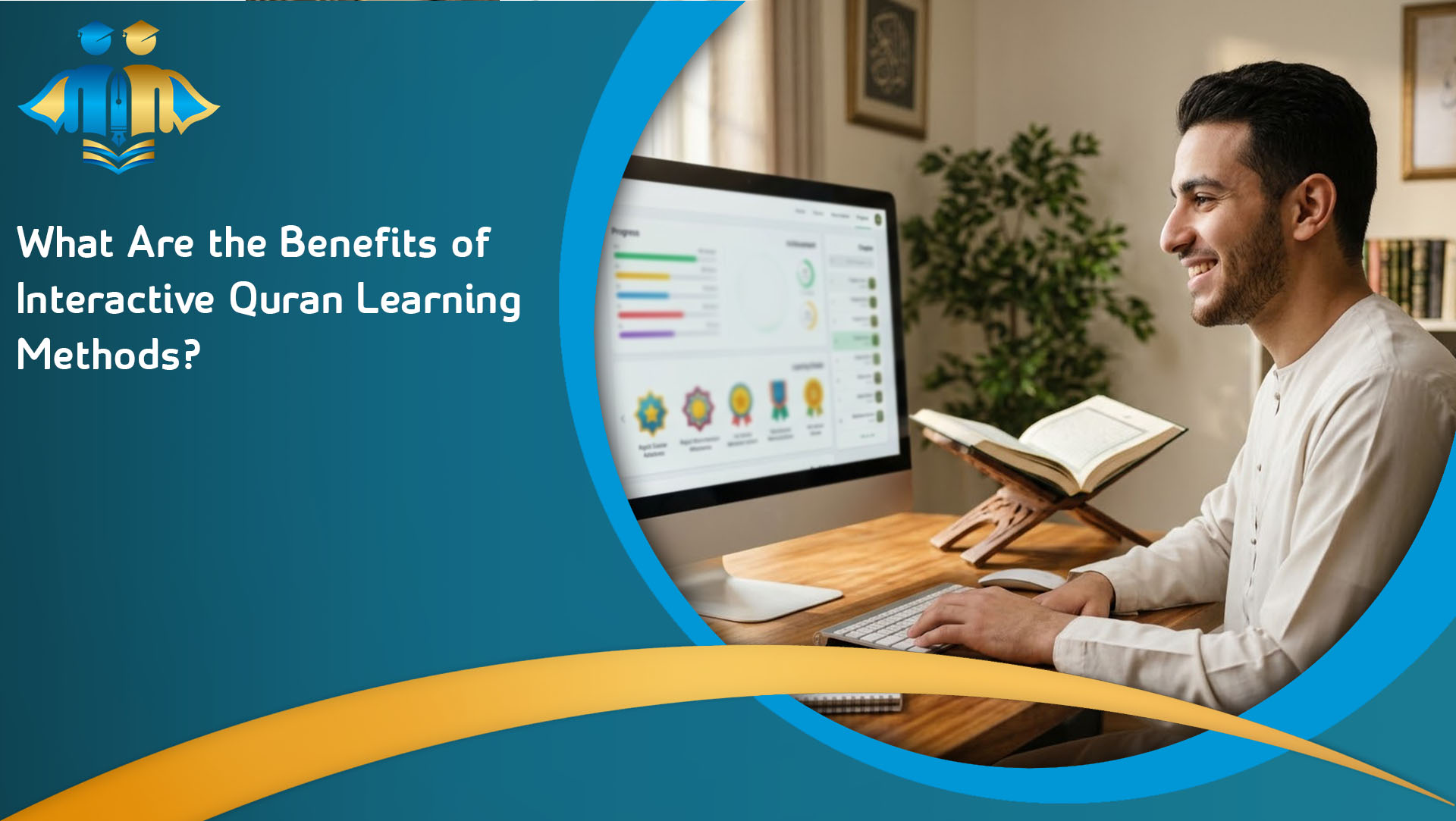
Interactive Quran Learning Methods offer several educational advantages when they are carefully planned and combined with correct instruction.
Their effectiveness depends on the student’s age, learning needs, teaching quality, and consistency of practice.
1. Greater Student Participation
Interactive activities encourage learners to contribute during lessons instead of listening passively. For example, answering questions, completing pronunciation exercises, and participating in discussions give students more opportunities to demonstrate their knowledge. Consequently, teachers can identify misunderstandings and adjust their explanations accordingly.
2. More Opportunities for Consistent Practice
Quran learning requires regular practice, especially when developing accurate pronunciation and memorizing verses. Interactive exercises provide additional opportunities to review previously studied material. For instance, short vocabulary quizzes and recitation activities can reinforce information between lessons.
3. Better Understanding of Learning Difficulties
Students do not all experience the same challenges. One learner may struggle with distinguishing similar Arabic letters, while another may need more support with memorization or Tajweed.
Interactive Quran Learning Methods help teachers observe these differences through practical activities. As a result, instruction can be adjusted to address specific learning difficulties.
4. Increased Motivation and Confidence
Achievable learning activities can make students feel more comfortable participating. For example, a child who successfully identifies Arabic letters or completes a revision exercise may become more willing to attempt the next activity. Similarly, adults can develop confidence by practicing recitation in a supportive environment.
5. Stronger Connections Between Knowledge and Daily Life
Discussing moral lessons and familiar situations helps students explore the practical relevance of Quranic teachings. Instead of memorizing information without context, learners can consider how values such as honesty, patience, mercy, and kindness relate to everyday decisions.
6. More Effective Teacher Feedback
Interactive lessons allow teachers to observe students while they practice. They can correct pronunciation, identify recurring mistakes, explain difficult concepts, and recommend additional exercises. This feedback is particularly important when learning Quran recitation and Tajweed.
7. Opportunities for Different Learning Preferences
Combining listening, speaking, reading, visual materials, and practical activities provides different ways to engage with the same lesson. Nevertheless, these activities should complement systematic teaching rather than rely on assumptions about fixed learning styles.
How to Teach the Quran in a Fun and Interactive Way?
Making Quran education enjoyable does not require turning every lesson into a game. Instead, teachers should create a balanced experience that combines clear instruction, meaningful practice, and suitable activities. Here are practical strategies for achieving this balance.
1. Combine Learning With Enjoyable Activities
Teachers can introduce short educational games after explaining a new concept. For example, after teaching Arabic letters, students can complete a recognition exercise or match letters with their correct sounds.
Likewise, a short revision challenge can help learners review previously studied material. The activity should always support the lesson’s main objective.
2. Introduce Quranic Stories at the Appropriate Level
Stories can help students explore Quranic events and their lessons. Teachers should select stories according to the learners’ age and explain unfamiliar vocabulary before asking questions.
Furthermore, they can encourage students to identify the main message of each story and connect it with suitable everyday examples.
3. Simplify Difficult Vocabulary and Concepts
Some Quranic words and Tajweed concepts require additional explanation, particularly for beginners and non-Arabic speakers. Therefore, teachers should introduce difficult information gradually. This makes challenging lessons easier to follow without sacrificing accuracy. Useful techniques include:
- Explaining unfamiliar vocabulary in simple language.
- Demonstrating pronunciation slowly.
- Comparing similar Arabic sounds.
- Dividing complicated rules into smaller steps.
- Providing examples followed by guided practice.
4. Connect Quran Lessons With Everyday Experiences
Teachers can discuss values such as kindness, patience, gratitude, and honesty through age-appropriate examples. For instance, a discussion about helping others can encourage students to recognize how Islamic teachings influence their behavior. Additionally, parents can reinforce these lessons through family conversations and positive examples.
5. Encourage Students to Ask Questions
An effective interactive lesson gives students enough time to ask questions. Teachers should welcome relevant questions, clarify misunderstandings, and explain unfamiliar concepts patiently.
Moreover, encouraging questions helps teachers understand which parts of the lesson require further explanation.
6. Use Short Activities With Clear Objectives
Long activities may become tiring, especially for younger learners. Instead, teachers can organize lessons into manageable sections. A lesson might include:
- A short introduction to the topic.
- Teacher demonstration.
- Guided recitation or reading.
- An interactive exercise.
- Feedback and correction.
- A brief revision activity.
How to Apply Interactive Quran Learning Methods for Kids?
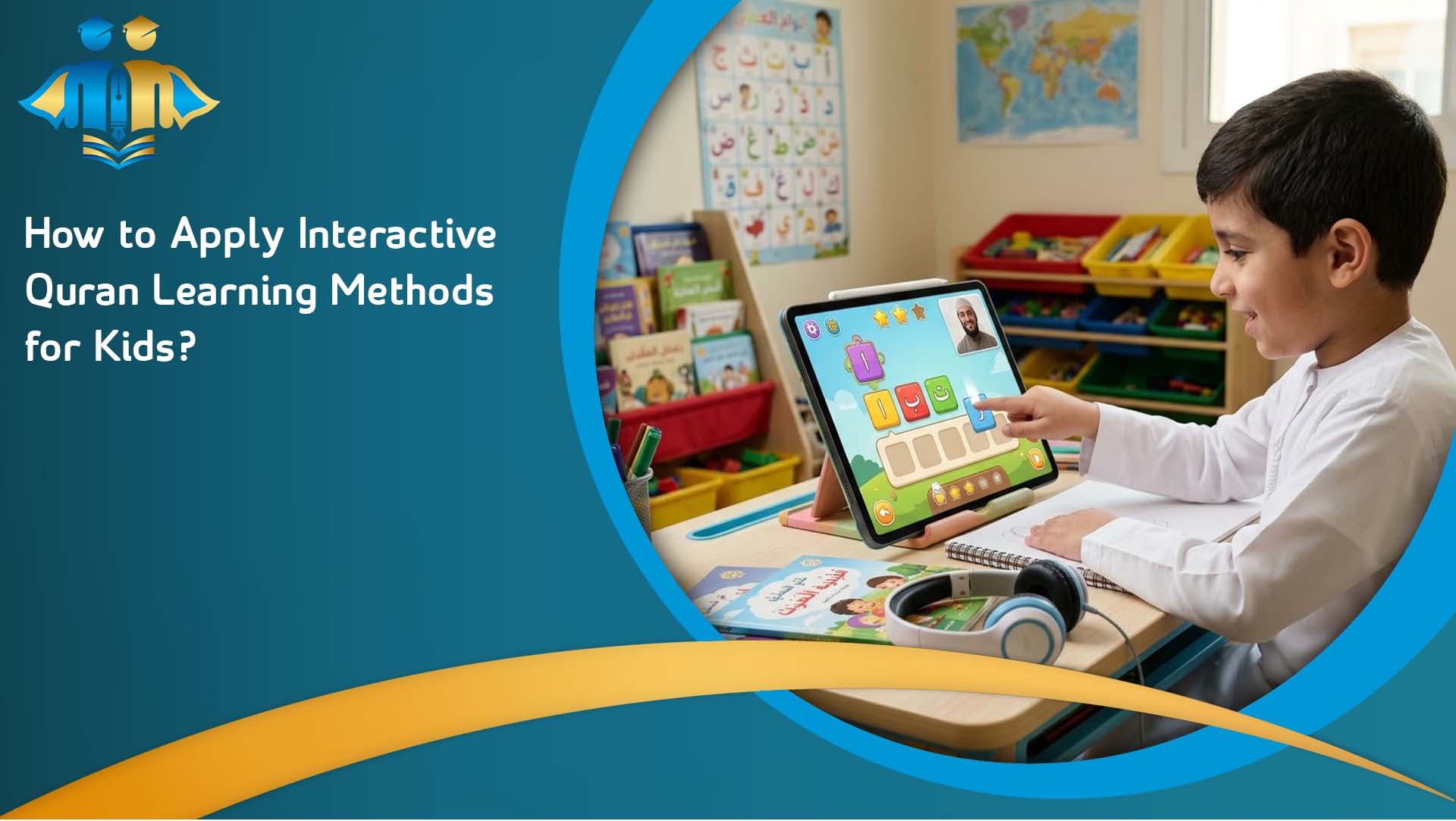
Children benefit from learning environments that consider their age, attention, language development, and individual abilities. Therefore, Interactive Quran Learning Methods for kids should combine simple explanations with frequent practice, creative activities, and encouraging feedback.
These Interactive Quran Learning Methods help young learners participate in lessons rather than simply listen to explanations. Moreover, teachers can adjust activities according to each child’s reading level, memorization ability, and individual learning needs.
1. Start With Age-Appropriate Learning Goals
Young beginners may need to recognize Arabic letters before progressing to connected letter forms and Quran reading.
Parents and teachers should avoid introducing advanced concepts before children develop the necessary foundations.
A suitable progression may include:
- Recognizing individual Arabic letters.
- Learning the different forms of connected letters.
- Practicing short vowel sounds.
- Reading simple Arabic combinations.
- Developing basic Quran reading skills.
- Introducing age-appropriate Tajweed rules.
The pace should depend on the child’s actual progress rather than an arbitrary deadline.
2. Adapt Activities to Each Child’s Abilities
Children develop at different rates. Some quickly recognize Arabic letters, while others require more repetition and individual guidance.
Teachers should observe how each child responds to different exercises. Accordingly, Interactive Quran Learning Methods should be adapted to address specific difficulties instead of requiring every student to follow the same learning pace.
For example, a child who struggles with visual letter recognition may benefit from additional identification activities and guided reading practice.
3. Use Repetition Without Making Lessons Monotonous
Repetition plays an important role in learning Arabic reading and Quran memorization.
However, repeating the same exercise continuously may reduce a child’s interest. Instead, teachers can introduce different Interactive Quran Learning Methods that reinforce the same learning objective.
For example, children can read a letter, identify it in a word, listen to its pronunciation, and complete a matching exercise.
4. Prioritize Accurate Recitation
Enjoyable activities should never replace correct Quran instruction. Children need opportunities to listen to accurate recitation, imitate the teacher, and receive corrections. Teachers should pay attention to pronunciation, letter articulation, and Tajweed rules according to the child’s learning level.
Parents who want additional guidance about selecting suitable instructors can explore Best Quran Teacher Online.
5. Encourage Family Participation
Parents can support their children’s learning by establishing a consistent routine. They do not need to become Quran teachers themselves. Instead, they can provide encouragement, organize revision time, and communicate with the instructor about learning progress.
For example, families can establish a short daily review period that fits their schedules. During Ramadan, parents can also introduce age-appropriate discussions about worship and Ramadan Fasting Rules.
6. Use Positive Encouragement
Children should receive constructive feedback when they make progress. Rather than focusing only on mistakes, teachers can recognize specific achievements, such as improved letter recognition or more accurate pronunciation.
This approach makes Interactive Quran Learning Methods more encouraging because children can recognize their achievements while understanding which areas still require attention.
7. Encourage Interaction With Other Learners
Group activities can help children develop communication skills and share their learning experiences. For example, students can participate in vocabulary games, revision questions, or supervised group discussions.
Furthermore, teachers can introduce pair activities in which children practice reading together and help each other remember previously studied vocabulary. However, teachers should ensure that group activities give every child an opportunity to participate.
8. Make Quran Learning a Positive Family Habit
Children often develop greater interest when they see family members reading and respecting the Quran. Parents can establish regular family recitation sessions and discuss suitable Quranic lessons together.
Additionally, families can organize educational activities around Islamic occasions and encourage children to ask questions about everyday religious practices. For example, parents may discuss Wudu after Ghusl when introducing appropriate lessons about purification.
Most importantly, the experience should remain encouraging rather than becoming a source of unnecessary pressure.
Interactive Quran Learning Methods for Adults
Interactive Quran education is not limited to children. Adults can also benefit from structured activities that make lessons more practical and responsive to their educational goals.
Many adult learners have different levels of Arabic knowledge, previous Quran experience, and available study time. Consequently, Interactive Quran Learning Methods for adults should focus on individual needs and clearly defined learning objectives.
For adult sisters who want to improve their recitation, exploring the best online Tajweed Classes for Sisters can help them understand the available learning options.
1. Set Clear Learning Objectives
Adults should identify what they want to achieve before beginning a learning program. Possible goals include:
- Improving Quran reading accuracy.
- Learning the basic rules of Tajweed.
- Correcting recurring pronunciation mistakes.
- Improving Quran memorization.
- Developing Arabic reading skills.
- Understanding selected Quranic vocabulary.
Clear goals help teachers select suitable activities and measure progress more effectively.
2. Practice Through Guided Recitation
Adults benefit from reading directly to a qualified Quran teacher who can listen and identify pronunciation mistakes. The teacher can demonstrate the correct sound and allow the student to repeat it.
This approach is especially valuable when distinguishing Arabic letters that may sound similar to non-native speakers. Moreover, Interactive Quran Learning Methods become more effective when students receive specific feedback instead of practicing pronunciation without correction.
3. Use Structured Revision Exercises
Memorization requires consistent revision. Adults can organize their revision through weekly schedules, recorded progress notes, and regular recitation assessments.
For example, a student can divide a memorized passage into smaller sections and review each section before connecting them. Teachers can also use short revision challenges to identify passages that require additional practice.
4. Participate in Meaningful Discussions
Adults may also benefit from discussions about Quranic vocabulary, selected verses, and reliable Tafsir explanations. These discussions provide opportunities to clarify questions and develop a more organized understanding of studied material. However, interpretation should remain grounded in recognized scholarly explanations.
5. Use Digital Learning Resources
Online dictionaries, recorded recitations, educational presentations, and digital revision tools can support independent practice.
Additionally, adults interested in developing their spoken Arabic may benefit from Arabic Speaking Classes alongside their Quran reading studies.
Nevertheless, these resources should supplement direct instruction when the learning objective involves pronunciation correction or detailed Tajweed assessment.
How to Choose the Right Interactive Quran Learning Methods?
Choosing suitable activities requires understanding the learner’s current abilities and educational goals. A method that works well for a young child may not be appropriate for an adult studying advanced Tajweed. Therefore, selecting Interactive Quran Learning Methods requires considering several important factors.
| Selection Factor | What to Consider | Suitable Approach |
|---|---|---|
| Age | The learner’s developmental level | Simple games for children |
| Experience | Beginner or advanced knowledge | Gradual instruction |
| Learning Objective | Reading, Tajweed, or memorization | Goal-specific exercises |
| Available Time | Lesson length and revision schedule | Short, organized activities |
| Learning Challenges | Pronunciation or comprehension difficulties | Individual feedback |
| Class Format | Individual or group instruction | Suitable collaborative exercises |
Additionally, teachers should review the effectiveness of their activities regularly.
If a student enjoys a game but does not demonstrate improvement in the intended skill, the teacher should adjust the activity.
The most effective Interactive Quran Learning Methods are not necessarily the most entertaining ones. Rather, they combine student participation with meaningful educational progress.
How to Measure Progress in Interactive Quran Learning?
Student participation alone does not demonstrate mastery. Teachers need appropriate ways to assess whether learners are developing the intended skills.
A structured assessment approach helps identify progress and areas requiring further attention. Furthermore, teachers can use the results to select more suitable Interactive Quran Learning Methods for upcoming lessons.
1. Assess Recitation Accuracy
Teachers can listen to students reading previously studied passages and identify recurring pronunciation errors. Assessment may consider:
- Correct pronunciation of Arabic letters.
- Application of previously taught Tajweed rules.
- Appropriate articulation points.
- Accuracy when reading familiar passages.
- Improvement in previously identified mistakes.
2. Review Memorization Regularly
Students working on Hifz should receive regular revision assessments. Teachers can ask learners to recite previously memorized passages and observe whether they can continue without frequent prompting.
They can also divide memorization assessments into smaller sections to identify which passages need additional revision.
3. Check Understanding Through Questions
Short questions can help teachers determine whether students understand the vocabulary or concepts covered in a lesson. However, questions should assess the actual learning objective rather than introduce unrelated topics.
For example, a student studying Arabic vocabulary can explain selected words before using them in another reading exercise.
4. Maintain Individual Progress Records
Teachers can record the topics covered, skills practiced, and areas needing additional attention. This makes it easier to adjust future lessons and communicate progress to students or parents.
Moreover, written records allow teachers to evaluate whether their Interactive Quran Learning Methods are helping students achieve their learning objectives.
5. Encourage Student Self-Assessment
Students can also reflect on their learning. For example, they may identify which pronunciation rule they understand well and which one requires more practice. This encourages responsibility and helps learners become more aware of their educational needs.
Common Mistakes to Avoid When Using Interactive Quran Learning Methods
Although interactive teaching offers useful opportunities, poorly planned activities can reduce their educational value. Teachers and parents should avoid the following mistakes.
1. Using games without educational objectives
Games should reinforce a specific skill, such as vocabulary recognition or Tajweed revision. Otherwise, they may distract from the main lesson.
2. Ignoring correct Quran recitation
Interactive exercises cannot replace listening to accurate recitation and receiving appropriate pronunciation corrections.
3. Introducing activities beyond the student’s level
Advanced vocabulary and complicated questions may discourage beginners. Teachers should introduce information gradually.
4. Overloading lessons with digital tools
Using too many applications or visual effects can distract students. Simple resources often provide a more focused experience.
5. Comparing students unfairly
Learners develop at different rates. Assessment should focus on individual progress rather than unnecessary competition.
6. Neglecting regular revision
An enjoyable lesson does not automatically produce long-term retention. Students still need consistent reading, repetition, and memorization practice.
7. Treating participation as proof of understanding
A student may enjoy an activity without fully understanding its content. Teachers should use appropriate assessments to confirm learning.
Interactive Quran Learning at Super Muslim Online Quran Academy
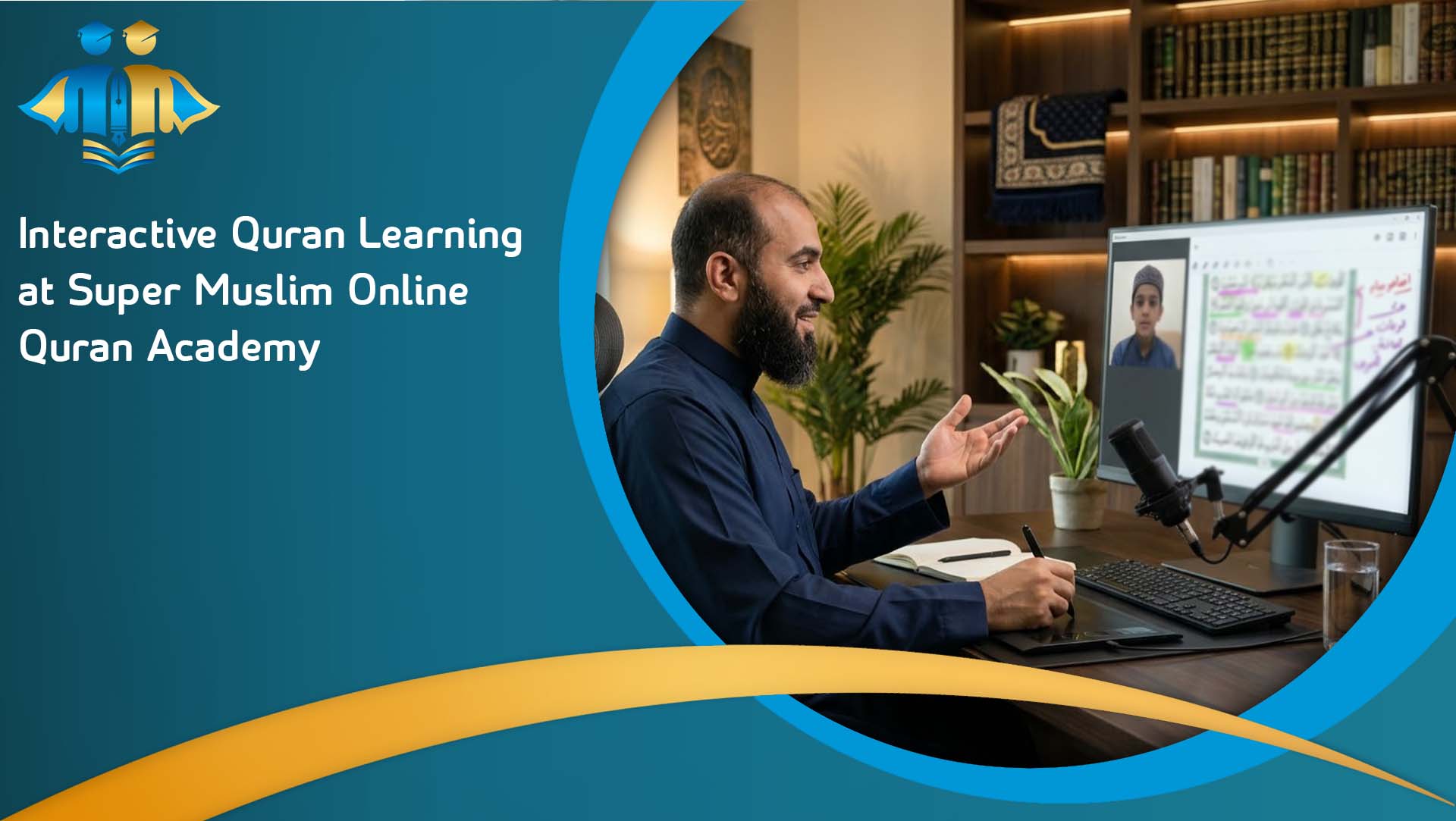
Choosing a suitable educational environment is an important part of developing a consistent Quran learning routine. Students need an approach that considers their learning goals, current abilities, and available study time.
Super Muslim Online Quran Academy is the academy to consider when exploring an online Quran learning journey. Before selecting a program, learners and parents should understand the available learning options and determine which activities match their educational needs. When evaluating Super Muslim Online Quran Academy, consider the following questions:
- Does the available program match the student’s current Quran reading level?
- Can the learning plan accommodate the student’s educational objectives?
- Are there opportunities for direct recitation practice?
- How are pronunciation mistakes addressed?
- What revision activities are suitable for the learner?
- How can parents or adult students follow educational progress?
Making Interactive Quran Learning Part of a Consistent Routine
The value of Interactive Quran Learning Methods becomes clearer when students practice consistently. For example, a learner can organize a weekly routine that combines reading, listening, memorization, and revision. A practical routine may include:
- A dedicated session for learning new material.
- Regular guided recitation practice.
- Short activities reviewing previous lessons.
- A weekly assessment of selected learning goals.
- Additional revision when a particular skill needs attention.
Super Muslim Online Quran Academy offers an option worth exploring for learners interested in Interactive Quran Learning Methods and organized online Quran education. Before enrolling, families should confirm the available courses, teaching methods, lesson arrangements, and student support.
Choosing suitable Interactive Quran Learning Methods depends on individual needs. Children may benefit from engaging activities, while adults may prioritize recitation correction and flexible lessons.
Contacting Super Muslim Online Quran Academy can help clarify which Interactive Quran Learning Methods are available and suitable for each learner.
Ultimately, effective Interactive Quran Learning Methods require consistent practice, suitable instruction, and accurate feedback. Therefore, discuss your learning goals with Super Muslim Online Quran Academy before making a decision.
Frequently Asked Questions About Interactive Quran Learning Methods
Find clear answers to common questions about using interactive methods to make Quran learning more engaging and effective.
1. What are Interactive Quran Learning Methods?
Interactive Quran Learning Methods are educational techniques that encourage students to participate actively instead of relying only on listening and memorization. They may include live recitation, teacher feedback, Quranic games, visual materials, quizzes, and practical exercises. These activities help learners understand lessons and apply what they study.
2. Are Interactive Quran Learning Methods suitable for young children?
Yes. Interactive Quran Learning Methods can make Quran education more engaging for children when activities match their ages and abilities. For example, teachers can use illustrated materials, repetition games, short recitation exercises, and simple questions. However, children still need regular guidance to develop correct pronunciation and consistent learning habits.
3. Can adults benefit from Interactive Quran Learning Methods?
Absolutely. Adults can use Interactive Quran Learning Methods to improve recitation, understand Tajweed rules, and review memorized verses. Live discussions and individual feedback also help adult learners identify mistakes and work on specific areas. The activities should reflect each student’s current level and learning objectives.
4. How can parents evaluate the effectiveness of Interactive Quran Learning Methods?
Parents can evaluate Interactive Quran Learning Methods by observing their children’s progress over time. They should look for improvements in pronunciation, lesson participation, understanding, and the ability to apply previously learned rules. Regular feedback from the teacher can also help parents identify strengths and areas that need additional practice.
Conclusion
Interactive Quran Learning Methods provide practical ways to make Quran education more engaging while supporting accurate recitation, memorization, and understanding. Through storytelling, educational games, group discussions, visual materials, and guided exercises, students can participate more actively in their learning journey.
However, interactive activities should always support the foundations of Quran education. Correct pronunciation, reliable explanations, regular revision, and suitable teacher guidance remain essential for meaningful progress.
Children may benefit from shorter activities, creative exercises, and family encouragement. In contrast, adults may prefer structured recitation practice, individual feedback, and learning plans that match their schedules.
Ultimately, the best Interactive Quran Learning Methods are those that respond to individual needs rather than following one teaching approach for everyone.
Super Muslim Online Quran Academy is an option to explore when considering an online Quran learning arrangement. Contact the academy to ask about its available programs and identify an approach that suits your educational goals.
Start with clear objectives, maintain a consistent routine, and make every Quran lesson an opportunity to learn, practice, and improve.

You may also like
Quran Memorization Schedule for Working Adults: A Guide

How to Choose the Right Online Quran Teacher for Your Child