

Arabic Speaking Classes: Improve Fluency and Confidence
Arabic Speaking Classes help learners develop the practical skills they need to communicate in Arabic, understand everyday conversations, and express their thoughts naturally. Effective Arabic Speaking Classes combine pronunciation practice, listening activities, guided conversations, and useful expressions that learners can apply in real situations.
Learning to speak Arabic can feel challenging at first, especially for English speakers who are unfamiliar with Arabic sounds and sentence structures. However, Arabic Speaking Classes make the process more manageable by providing a clear learning sequence and regular opportunities to speak.
At Super Muslim Online Quran Academy, learners can explore a structured approach to Arabic learning. Whether you’re starting from scratch or already understand some Arabic, Arabic Speaking Classes can turn passive knowledge into practical communication skills.
This guide explains how Arabic Speaking Classes work, what learners should study at each stage, and which daily practices can improve conversational Arabic.
How Do Arabic Speaking Classes Build Practical Communication Skills?

Arabic Speaking Classes are lessons designed to help students use Arabic in spoken communication. Their main purpose is to help students understand questions, respond appropriately, pronounce words clearly, and participate in conversations.
Unlike lessons based entirely on textbooks, Arabic Speaking Classes give learners opportunities to use the language actively. They may practise introducing themselves, describing daily routines, asking for information, and discussing familiar topics.
For beginners, Arabic Speaking Classes usually start with short expressions and basic sentence patterns. As confidence improves, students move towards longer exchanges, broader vocabulary, and more independent conversations.
A well-structured program combines vocabulary development, pronunciation practice, listening comprehension, sentence formation, and conversational activities. Together, these skills help learners communicate more effectively.
Start Learning the Quran with Trusted Egyptian Teachers Today
Ready to improve your Quran recitation, master Tajweed, or begin memorizing the Holy Quran with confidence? At Super Muslim Online Quran Academy, our experienced Egyptian Quran teachers provide personalized one-on-one lessons tailored to your age, level, and goals.
Enjoy flexible scheduling, live guidance, and a supportive learning environment that helps you make steady progress from the comfort of your home. Book your free trial class today and take the first step toward a stronger connection with the Book of Allah.

Why Choose Arabic Speaking Classes Instead of Studying Grammar Alone?
Grammar is important, but understanding a rule does not automatically mean that a learner can use it while speaking. Many students complete written exercises successfully yet struggle to answer simple questions without translating every word.
Arabic Speaking Classes bridge this gap by connecting grammatical knowledge with practical communication. Students learn useful expressions, practise them in context, and gradually understand the patterns behind the sentences they use.
For example, a beginner may memorize “أريد ماءً” (I want water). During Arabic Speaking Classes, the teacher can ask the student to use the same structure with different words, such as food, coffee, or assistance.
This approach makes grammar more practical and helps learners recognize how familiar patterns can be adapted to new situations. Consequently, students develop both accuracy and confidence.
Who Can Benefit from Arabic Speaking Classes?
Arabic Speaking Classes can support learners with different backgrounds, ages, and objectives. The most suitable starting point depends on what a student already knows and what they want to achieve.
Arabic Speaking Classes for Complete Beginners
Beginners need a simple, practical introduction to Arabic. At this stage, Arabic Speaking Classes focus on greetings, personal introductions, basic questions, and short responses.
Students may practise expressions such as:
- السلام عليكم — Peace be upon you.
- ما اسمك؟ — What is your name?
- اسمي أحمد — My name is Ahmed.
- كيف حالك؟ — How are you?
- أنا بخير — I am fine.
These expressions provide a foundation for short conversations. Through Arabic Speaking Classes, learners can gradually personalize dialogues, ask additional questions, and create new sentences without relying entirely on memorized scripts.
Arabic Speaking Classes for Learners Who Understand but Cannot Speak
Some students understand written Arabic or recognize familiar expressions but find it difficult to respond verbally. Their receptive skills may be stronger than their speaking skills.
Arabic Speaking Classes help these learners retrieve familiar vocabulary, construct short responses, and speak without translating every sentence from their first language.
A useful exercise involves answering familiar questions in several different ways. As students improve, teachers can introduce follow-up questions that encourage longer responses and more spontaneous communication.
Arabic Speaking Classes for Adults
Adult learners often have specific reasons for studying Arabic. Some want to communicate with Arabic-speaking colleagues, while others wish to travel or connect with family members.
Arabic Speaking Classes for adults can focus on relevant situations and build upon existing knowledge. A learner preparing for travel, for instance, might prioritize asking for directions, making requests, and communicating basic needs.
Adults also benefit from brief explanations that clarify differences between similar expressions without turning every lesson into a lengthy grammar session.
Arabic Speaking Classes for Heritage Learners
Heritage learners may understand family conversations but struggle to explain their thoughts or construct longer sentences.
In these cases, Arabic Speaking Classes should recognize existing listening ability and focus on active vocabulary, sentence organization, pronunciation, and more independent communication.
An initial assessment can help identify differences between speaking, listening, reading, and writing abilities so that lessons address the learner’s actual needs.
What Will You Learn in Arabic Speaking Classes?
Arabic Speaking Classes should move from simple, familiar communication towards more flexible and independent speaking. Although the sequence varies according to the learner’s level, several core areas are particularly useful. Learners can also explore learn arabic online in usa to develop their language skills through structured lessons that suit their learning goals.
1. Arabic Greetings and Self-Introductions
Arabic Speaking Classes introduce greetings, personal introductions, and polite expressions used when beginning or ending conversations.
Students practise introducing themselves, asking another person’s name, and exchanging basic information. They then personalize these exchanges by discussing their professions, interests, or reasons for learning Arabic.
For younger learners, online Arabic classes for kids can provide age-appropriate speaking activities that encourage children to use familiar expressions independently.
2. Everyday Arabic Vocabulary and Useful Expressions
Vocabulary becomes more useful when learners can apply it in realistic situations. Arabic Speaking Classes introduce words related to food, family, transportation, shopping, work, and daily activities.
For example, students studying food vocabulary can practise expressing preferences, naming dishes, and ordering meals. These activities help them understand how words function in complete sentences.
Regular revision also makes it easier to retrieve vocabulary during conversations. Choosing the best place to learn Arabic can help learners find structured opportunities to practise vocabulary and apply it in everyday situations.
3. Arabic Pronunciation and Clear Speech
Arabic contains sounds that may be unfamiliar to English speakers. Letters such as ع, ح, خ, غ, ق, and ص can require additional practice because they do not always have direct equivalents in English.
Arabic Speaking Classes help learners recognize these sounds, understand how they are produced, and practise them in individual words before using them in sentences.
For instance, ح and ه represent different sounds. Listening to clear examples and receiving specific correction can help students distinguish between them.
Pronunciation practice should also include rhythm, connected speech, and the way sounds change when words are spoken together. The goal is clear, understandable communication rather than eliminating every trace of a learner’s original accent.
4. Forming Questions and Giving Natural Answers
Questions keep conversations moving. Arabic Speaking Classes therefore help learners ask for information and respond appropriately.
Useful question words include من؟ (Who?), ماذا؟ (What?), أين؟ (Where?), متى؟ (When?), لماذا؟ (Why?), كيف؟ (How?), and كم؟ (How much or how many?).
Students begin with simple questions and gradually combine them in longer conversations. This process develops listening skills, grammatical accuracy, and the ability to respond naturally.
5. Building Complete Arabic Sentences
Knowing individual words is only one part of communication. Arabic Speaking Classes also help learners arrange words into sentences that express complete thoughts.
Early lessons may focus on short statements about personal information and everyday activities. Later, students can explain preferences, describe experiences, and connect ideas.
For example, a learner might progress from “أحب القراءة” (I like reading) to a longer sentence explaining when and why they enjoy reading.
By expanding sentences gradually, learners develop the ability to communicate more detailed information without attempting complicated structures too early.
6. Listening and Responding in Real Time
Conversations require learners to understand what another person says and respond appropriately. Arabic Speaking Classes combine listening activities with questions, short dialogues, and spoken responses.
At first, students may listen to slow, clearly articulated speech. As comprehension improves, they can work with more natural speaking speeds and a wider range of expressions.
After listening, learners can summarize the main idea, answer questions, or continue the dialogue. For children who are also developing their Quran learning skills, practising how to learn quran for kids can complement their exposure to Arabic pronunciation, although Quranic recitation and conversational Arabic have different learning objectives.
7. Expressing Opinions and Discussing Familiar Topics
Once learners can manage basic exchanges, Arabic Speaking Classes should introduce opportunities to express opinions and explain ideas.
Topics such as education, hobbies, travel, food, and daily routines provide useful starting points. Students can focus on expressing themselves rather than inventing unfamiliar ideas.
Teachers may introduce expressions for agreement, disagreement, preference, comparison, and explanation. As a result, learners become less dependent on memorized dialogues.
Learners seeking more structured practice can consider Arabic language classes online to strengthen their speaking skills through guided exercises, interactive discussions, and regular feedback.
Which Type of Arabic Should You Learn for Speaking?
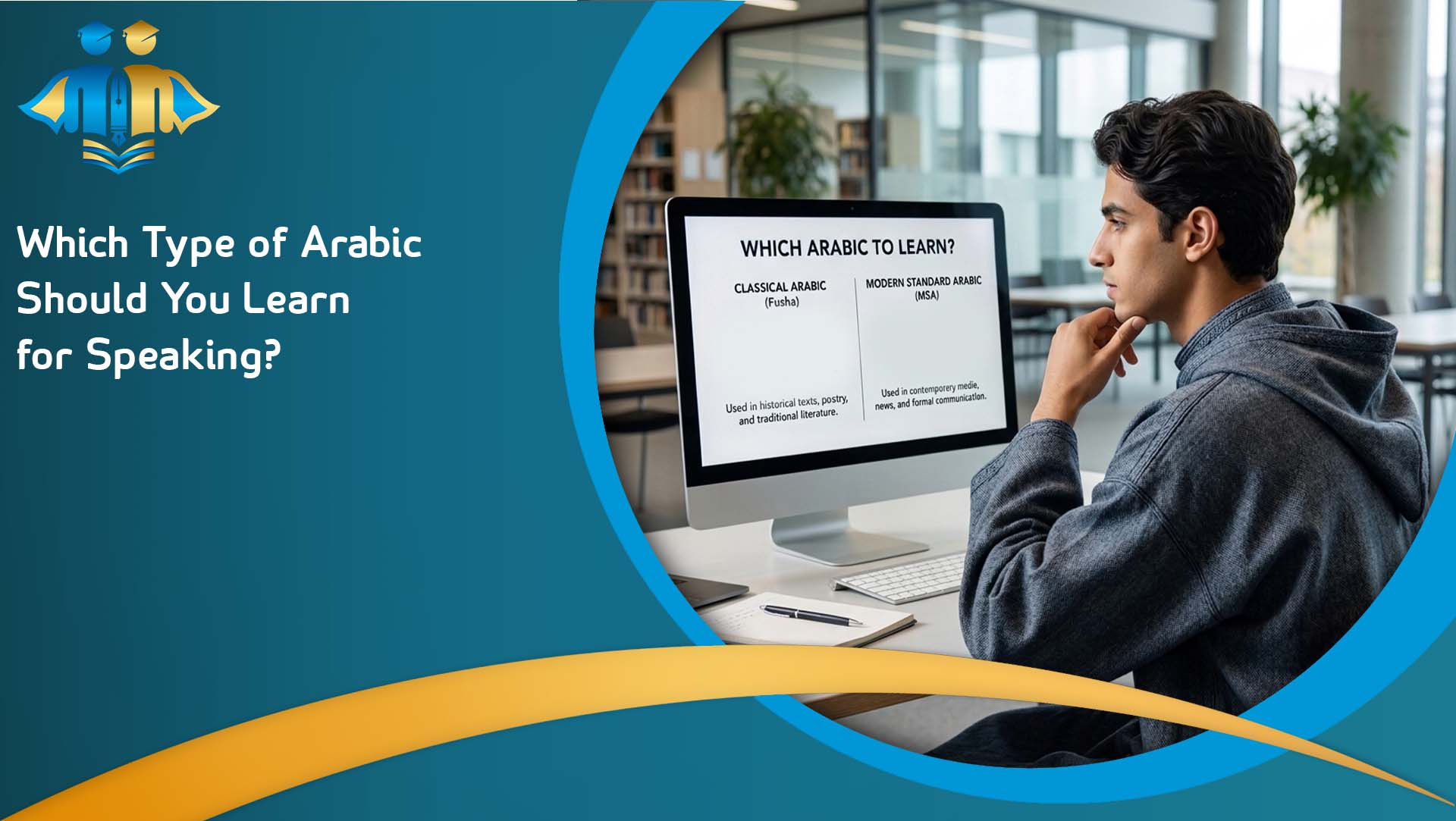
Before choosing Arabic Speaking Classes, students should consider which language variety matches their goals. Arabic is not used in exactly the same way in every country or setting.
Modern Standard Arabic for Formal Communication
Modern Standard Arabic is widely used in formal writing, news broadcasts, educational materials, and official contexts.
Learners who want to understand written Arabic or read educational texts may benefit from studying this variety. However, everyday conversations often include regional expressions and dialects that differ from formal Arabic.
Arabic Speaking Classes should therefore reflect the situations in which students expect to communicate.
Other Arabic Dialects
Arabic dialects include Levantine, Gulf, Moroccan, and other regional varieties. These differ in pronunciation, vocabulary, and everyday expressions.
Someone preparing to live in Jordan may have different needs from a learner moving to Saudi Arabia or Morocco.
Choosing the appropriate variety helps ensure that Arabic Speaking Classes address the learner’s actual communication goals. In some cases, studying Modern Standard Arabic alongside a regional dialect may be useful.
How Do Online Arabic Speaking Classes Work?
Online Arabic Speaking Classes allow learners to study without travelling to a physical classroom. However, their effectiveness depends on how well lessons encourage active participation.
A productive lesson gives students opportunities to speak, receive feedback, and apply corrections. Watching a teacher explain the language without practising it is unlikely to develop conversational ability on its own.
Individual Lessons and Personalized Feedback
Private lessons allow the teacher to focus on one student’s current ability and learning objectives.
For example, a beginner who struggles with pronunciation may need more listening and repetition. Another student who understands Arabic but hesitates while speaking may benefit from spontaneous questions and extended dialogue.
Arabic Speaking Classes can be adapted to these differences, helping learners focus on specific weaknesses rather than following an identical pace regardless of ability.
Flexible Scheduling and Consistent Practice
A convenient schedule helps learners maintain regular contact with Arabic. Students should choose lesson times that fit their responsibilities and leave enough room for revision.
Short, frequent practice sessions are often easier to sustain than occasional periods of intensive study. Even ten or fifteen minutes of focused speaking practice can reinforce expressions introduced during a lesson.
Consistency is more important than the length of any single practice session.
Learning with a Suitable Teacher
A suitable teacher should explain language patterns clearly, model understandable pronunciation, and identify errors constructively.
Arabic Speaking Classes are more useful when learners feel comfortable asking questions and making mistakes. A supportive environment encourages participation rather than silence caused by fear of being incorrect.
Teachers should also adjust the pace of instruction according to the student’s progress.
How to Choose the Right Arabic Speaking Classes
Choosing a program requires more than comparing lesson descriptions. Learners should consider their goals, current level, preferred learning style, and the amount of speaking practice included.
Identify Your Main Learning Objective
Start by deciding what you want to accomplish. Your goal might be to communicate while travelling, speak with relatives, participate in workplace conversations, or understand everyday interactions.
A clear objective helps determine which vocabulary and speaking situations deserve priority. Arabic Speaking Classes should reflect these needs rather than focus on unrelated material.
Check Whether Lessons Include Active Conversation
A speaking-focused program should require students to produce language regularly.
Look for opportunities to answer questions, create original sentences, participate in role-play, and respond to unfamiliar prompts. These activities reveal whether learners can use Arabic independently rather than simply repeat what they hear.
Understand How Progress Is Assessed
Progress should be evaluated through observable communication skills rather than the number of lessons completed.
A learner may initially introduce themselves using memorized expressions. Later, they may answer follow-up questions, explain preferences, and maintain longer conversations.
Arabic Speaking Classes should include realistic opportunities to review these developments and identify areas requiring additional practice.
Consider Whether the Program Matches Your Level
Beginners need clear models and manageable tasks, while intermediate learners generally require more varied conversations.
If lessons are consistently too easy, learners may not develop new skills. Conversely, activities that are too difficult can make participation frustrating.
The ideal starting point challenges students without making successful communication unnecessarily difficult.
A Practical Learning Plan for Arabic Speaking Classes

A structured plan helps learners understand what to practise first and how to build upon earlier skills. The following sequence can be adapted to individual needs.
Stage One: Develop Basic Communication
Begin with greetings, self-introductions, common expressions, numbers, and essential questions. During Arabic Speaking Classes, practise producing short sentences aloud instead of relying exclusively on written notes.
Once an expression feels familiar, change individual words to create new sentences. This turns a memorized statement into a practical exchange.
Stage Two: Expand Everyday Vocabulary
Organize vocabulary around familiar situations, such as food, family, work, shopping, transportation, and daily routines.
Choose words that can be applied immediately and use them in complete sentences. Revisit previously learned vocabulary regularly to make recall easier.
Stage Three: Improve Sentence Formation and Pronunciation
Focus on producing clearer sentences and correcting recurring pronunciation errors.
Practise difficult sounds individually, then use them in words, short phrases, and complete sentences. You can also record short speaking samples to compare your performance over time.
Stage Four: Participate in Longer Conversations
Once basic communication becomes more comfortable, practise discussing familiar topics without preparing every sentence in advance.
A teacher might ask you to describe your day, explain a preference, or respond to an unexpected question. Arabic Speaking Classes at this stage should encourage flexibility, self-correction, and independent communication.
How to Improve Your Arabic Speaking Skills Between Lessons
Lessons provide direction and correction, but regular independent practice helps turn new knowledge into lasting skills.
Speak Aloud Every Day
Choose a familiar topic and speak about it for a few minutes. You might describe your morning routine or discuss a meal you enjoy.
As you become more comfortable, add details and connect ideas. When you cannot express a thought, identify the missing word or phrase and review it later.
Listen to Arabic You Can Understand
Listening regularly helps learners become familiar with pronunciation, rhythm, and common expressions.
Choose material close to your current level. After listening to a short passage, repeat selected expressions and explain what you understood.
Use Shadowing Carefully
Shadowing involves listening to a short passage and repeating it while following the speaker’s rhythm and pronunciation.
Start with a brief sentence, listen several times, and repeat it until you can reproduce it more clearly. Make sure you understand the meaning and can use the expression in another sentence.
Practise Questions and Answers
Prepare questions related to your current topic. Answer them aloud, then change the wording or provide additional details.
If possible, ask a teacher or conversation partner to introduce follow-up questions. This makes practice more realistic and prepares you for unexpected responses.
Keep a Record of Repeated Mistakes
Create a simple list of pronunciation problems, vocabulary gaps, and sentence patterns that require attention.
Review the list before your next lesson and practise the corrected forms. Focus on recurring errors rather than attempting to correct everything at once.
Common Mistakes to Avoid When Learning to Speak Arabic
Some habits can slow progress even when students devote considerable time to studying.
Waiting Until Your Grammar Is Perfect
Many beginners delay speaking because they believe they must understand every rule first. Instead, Arabic Speaking Classes should encourage learners to begin with simple expressions and improve them gradually.
Memorizing Words Without Using Them
Vocabulary lists can be useful, but words are harder to recall when they have never been used in context. Create short sentences and practise them in meaningful dialogues.
Translating Every Sentence from English
Translating every sentence before speaking can make responses slow and mentally demanding. As you become familiar with common patterns, practise responding directly to familiar questions.
Ignoring Pronunciation Errors
Unfamiliar sounds may require focused listening, repeated practice, and correction. Pay attention to sounds that change a word’s identity and practise them in meaningful examples.
Practising Only with Prepared Dialogues
Prepared dialogues help beginners, but real conversations rarely follow a completely predictable script. Change questions, replace key words, and introduce new details to develop flexible communication.
How Super Muslim Online Quran Academy Can Support Your Arabic Learning
Super Muslim Online Quran Academy is the academy to consider when exploring an online learning option aligned with your Arabic learning goals.
Before starting, identify the skills you want to develop and discuss your current ability with the academy. Arabic Speaking Classes are most useful when learning objectives are clear, and practice addresses the student’s actual needs.
Important priorities may include pronunciation, everyday expressions, sentence formation, listening comprehension, and guided conversation. Learners who already know some Arabic may also benefit from identifying situations in which they struggle to communicate.
A suitable learning plan should explain what the student will practise, how feedback will be provided, and how progress can be evaluated. Regular participation and independent revision remain important parts of the process.
By combining appropriate instruction with realistic goals and consistent practice, learners can work steadily towards clearer Arabic communication.
What Results Can You Expect from Arabic Speaking Classes?
Results depend on the learner’s starting level, the Arabic variety being studied, lesson frequency, and the amount of independent practice completed.
During the early stages, students may become more comfortable with greetings, basic questions, and short introductions. With continued practice, Arabic Speaking Classes can help learners work towards longer responses, clearer pronunciation, and better understanding of familiar conversations.
Later progress may involve discussing personal experiences, explaining opinions, and responding to less predictable questions. However, these abilities do not develop at the same rate for everyone.
Rather than measuring success only by the number of words memorized, consider whether you can communicate more clearly and respond with less hesitation. Useful progress indicators include:
- Answering familiar questions without reading a prepared script.
- Pronouncing previously difficult sounds more clearly.
- Understanding the main idea of short conversations.
- Forming longer sentences with fewer errors.
- Asking follow-up questions during an exchange.
- Recovering more comfortably when you forget a word.
These indicators provide a practical way to evaluate development and adjust your learning plan.
Frequently Asked Questions About Arabic Speaking Classes
Find answers to common questions about Arabic Speaking Classes, including learning methods, pronunciation, Arabic dialects, and practical speaking skills.
1. Can I learn to speak Arabic if I have never studied it before?
Yes. Beginners can start with greetings, simple questions, everyday vocabulary, and short sentences. Regular practice and constructive feedback help build skills gradually.
2. Should I learn Modern Standard Arabic or an Arabic dialect first?
The answer depends on your goals. Modern Standard Arabic is useful for formal contexts and educational purposes, while a dialect may be more practical for everyday conversations in a particular country.
3. How can I practise Arabic speaking without a conversation partner?
You can describe familiar activities aloud, answer recorded questions, repeat short audio passages, and practise role-play. Recording your voice also helps you identify areas for improvement.
4. Is it necessary to learn Arabic reading and writing to improve speaking?
Not always. Some speaking activities can begin through listening and verbal practice. Nevertheless, learning the Arabic alphabet and recognizing written words can support vocabulary development and independent revision.
5. How do I know whether my Arabic speaking skills are improving?
Compare your ability to complete similar speaking tasks over time. Notice whether you can answer more questions, use a wider range of expressions, pronounce words more clearly, and maintain conversations with less support.
In Conclusion: Learning to communicate in Arabic becomes more manageable when practice has a clear purpose. Begin with useful expressions, develop your pronunciation, and use new vocabulary in meaningful conversations.
As your ability improves, move beyond memorized phrases and practise answering unfamiliar questions, explaining opinions, and discussing everyday experiences. Consistent listening and speaking practice will help you identify weaknesses and build upon existing skills.
Super Muslim Online Quran Academy can be explored as a learning option when choosing a suitable path for your Arabic studies. Start by defining your goals, identifying your current level, and determining which skills need the most attention. With realistic expectations, regular practice, and appropriate guidance, you can work towards clearer and more confident Arabic communication.

You may also like


Arabic alphabet for beginners: Quick Learning Guide