Islamic Laws for Women: A Guide to Rights and Duties
Islamic Laws for Women provide guidance on many areas of a Muslim woman’s life, including worship, marriage, financial rights, education, modesty, family responsibilities, and personal dignity. Understanding these teachings requires looking at the Quran and authentic Sunnah while also recognizing that some rulings have different scholarly interpretations.
For many people searching for Islamic Laws for Women, the main challenge is separating authentic Islamic teachings from cultural traditions or generalizations about Muslim women. A clear explanation should therefore distinguish between religious principles, specific legal rulings, and practices that differ between communities.
This guide explores the major areas that commonly raise questions about women in Islam. It explains their rights and responsibilities practically while avoiding the assumption that every Muslim society applies Islamic teachings in the same manner.
For learners who want to understand these subjects through structured Islamic education, Super Muslim Online Quran Academy can provide an online learning environment where students can study Islamic topics alongside Quranic learning.
What Are Islamic Laws for Women?
The term Islamic Laws for Women refers to Islamic rulings and principles that address matters affecting women. These teachings come primarily from the Quran and Sunnah, while detailed legal conclusions have also been developed by Muslim scholars through different schools of Islamic jurisprudence.
Therefore, Islamic law should not be understood as one simple list of rules. Some matters have clear textual evidence, while others involve scholarly interpretation and differences of opinion.
The Quran addresses women directly in numerous passages. It discusses matters such as marriage, inheritance, divorce, modesty, family relationships, worship, and financial ownership. At the same time, women and men share fundamental religious responsibilities, including belief, prayer, fasting, charity, and accountability before Allah.
When studying Islamic Laws for Women, it is also important to distinguish religious teachings from cultural customs. A practice found in a particular Muslim country or community does not automatically represent an Islamic ruling.
Sources Behind Islamic Laws for Women
Islamic rulings are generally studied through several sources and methods, including:
- The Quran, which is the primary source of Islamic guidance.
- The Sunnah, which records the teachings, statements, and practices of Prophet Muhammad.
- Scholarly interpretation and Islamic jurisprudence.
- Established principles used by qualified scholars when addressing matters not directly explained in one specific verse or hadith.
Consequently, students should be cautious when encountering claims online that begin with statements such as “Islam always allows” or “Islam never allows” without evidence or context.
Learning Islamic Laws for Women through reliable educational resources can help students understand why a ruling exists rather than memorizing isolated statements.
Start Learning the Quran with Trusted Egyptian Teachers Today
Ready to improve your Quran recitation, master Tajweed, or begin memorizing the Holy Quran with confidence? At Super Muslim Online Quran Academy, our experienced Egyptian Quran teachers provide personalized one-on-one lessons tailored to your age, level, and goals.
Enjoy flexible scheduling, live guidance, and a supportive learning environment that helps you make steady progress from the comfort of your home. Book your free trial class today and take the first step toward a stronger connection with the Book of Allah.

Understanding Islamic Laws for Women and Equality in Islam
One of the most common questions about Islamic Laws for Women concerns equality between men and women. Islamic teachings establish that both men and women are accountable to Allah and can earn spiritual reward through faith and righteous actions.
The Quran states that believing men and believing women are allies of one another and describes both as responsible for supporting what is right and avoiding what is wrong. It also repeatedly connects faith and righteous deeds with reward without making salvation dependent on gender.
However, equality in Islamic theology does not necessarily mean that every legal responsibility is identical for men and women. Islamic jurisprudence sometimes assigns different responsibilities according to circumstances, family roles, financial obligations, or biological differences.
For this reason, discussions about Islamic Laws for Women are clearer when they distinguish between spiritual equality and differences in particular legal responsibilities.
Spiritual Responsibilities of Muslim Women
- Believing in Allah and His Messenger.
- Performing the prescribed prayers.
- Fasting during Ramadan.
- Paying zakat when its conditions are met.
- Performing Hajj when financially and physically able.
- Avoiding prohibited actions.
- Seeking beneficial knowledge.
- Maintaining good character and fulfilling responsibilities.
The Quran emphasizes that righteous deeds performed by believing men and women are valued by Allah. This principle forms an important part of understanding the spiritual status of women in Islam.
For anyone studying Islamic Laws for Women, this distinction matters because religious accountability applies to women as complete moral and spiritual individuals rather than treating them as secondary participants in religious life.
Islamic Laws for Women and the Right to Education
Education is another major subject within Islamic Laws for Women. Islam encourages the pursuit of beneficial knowledge, and Muslim women throughout Islamic history have participated in religious scholarship, teaching, medicine, trade, and other areas of learning.
A well-known example is Aisha bint Abu Bakr, who became an important source of Islamic knowledge and transmitted a large number of hadith. Her role demonstrates that women have historically contributed to the preservation and teaching of Islamic knowledge.
Education, however, should not be reduced to memorizing religious information. Beneficial knowledge can include religious studies as well as knowledge that helps a person fulfill legitimate responsibilities and contribute positively to society.
Why Islamic Knowledge Matters for Women
Understanding Islamic Laws for Women can help a Muslim woman make informed decisions about worship, family responsibilities, financial matters, and personal conduct. For example, studying Islamic jurisprudence can help a woman understand:
- Her responsibilities during Ramadan.
- The basic rules related to purification and prayer.
- Her rights within marriage.
- The principles of inheritance.
- Matters related to divorce and waiting periods.
- Appropriate standards of modesty.
- Her financial rights and responsibilities.
However, online articles should not replace qualified scholarly guidance when a person is dealing with a complicated personal legal question.
For students who want a structured way to study Quran and Islamic subjects online, Super Muslim Online Quran Academy can be considered as an educational option for learners who prefer guided online study.
Islamic Laws for Women in Marriage
Marriage occupies an important place in Islamic Laws for Women. Islamic marriage is not simply a social arrangement; it is a contract that establishes rights and responsibilities for both spouses.
A valid Islamic marriage involves specific requirements, including the agreement of the spouses and the fulfillment of conditions recognized by Islamic jurisprudence. The details can differ between schools of law, particularly regarding the role of a guardian and witnesses.
One important financial right is mahr, which is given to the bride as part of the marriage arrangement. Mahr belongs to the wife, and she has authority over her own property.
Islam also instructs husbands to treat their wives with kindness and fairness. The Quran describes marriage through concepts such as affection, mercy, and tranquility.
Financial Rights Under Islamic Laws for Women
Among the important Islamic Laws for Women are rules concerning financial ownership. A Muslim woman can own property and possess wealth independently.
Marriage does not automatically transfer a woman’s property to her husband. Likewise, money that belongs to a woman remains hers unless she willingly chooses to give or spend it.
This distinction is important because Islamic marriage does not eliminate a woman’s independent financial identity. A woman may own:
- Money.
- Property.
- Business assets.
- Inherited wealth.
- Gifts.
- Mahr.
- Other lawful possessions.
The husband has financial responsibilities toward his wife and, where applicable, his family. These responsibilities are separate from the wife’s ownership of her personal wealth.
Therefore, understanding Islamic Laws for Women requires looking at both rights and financial duties rather than discussing inheritance or household expenses in isolation.
Islamic Laws for Women and Inheritance
Inheritance is one of the areas in which Islamic Laws for Women provide specific financial rules. The Quran establishes shares for eligible heirs, including women.
A daughter, wife, mother, sister, or another female relative may have an inheritance entitlement depending on the family circumstances and the surviving heirs.
It is important not to assume that every woman always receives half of what every man receives. Islamic inheritance calculations depend on the relationship between the deceased and the heirs and on which relatives are alive.
In some circumstances, a female heir receives half the share of a corresponding male heir. In other circumstances, the shares can be different, and some women may inherit while certain male relatives do not.
Why Inheritance Cannot Be Explained by One Rule?
Discussions about Islamic Laws for Women often become inaccurate when inheritance is summarized in one sentence such as “women always inherit half as much as men.”
That statement is too broad.
The Islamic inheritance system is based on defined relationships and circumstances. In addition, financial obligations are not identical for every heir.
Because inheritance can become complicated, families should seek qualified Islamic legal guidance when dividing an actual estate. A simple online article cannot calculate every possible inheritance situation.
Understanding these rules also helps students recognize that inheritance in Islam is a structured legal subject rather than a general statement about the value of women.
Islamic Laws for Women and Employment
Questions about employment frequently appear in discussions of Islamic Laws for Women. Islamic history includes women who participated in trade, education, medicine, and other forms of social activity.
Khadijah bint Khuwaylid, the wife of Prophet Muhammad, is widely known for her involvement in commerce before her marriage to the Prophet.
The permissibility of a particular job can depend on the nature of the work, the environment, contractual conditions, and Islamic ethical requirements. Therefore, it is more accurate to discuss employment according to the specific circumstances rather than declaring that Muslim women either can or cannot work.
A woman may seek lawful employment while observing relevant Islamic obligations and avoiding prohibited activities.
Balancing Work and Family Responsibilities
Islamic Laws for Women do not reduce a woman’s entire identity to either employment or domestic responsibilities. Different families make different arrangements according to their circumstances. A married couple may need to discuss:
- Household responsibilities.
- Childcare.
- Working hours.
- Financial contributions.
- Living arrangements.
- Religious and family commitments.
Mutual consultation can help spouses create an arrangement that respects both people’s rights and responsibilities.
At the same time, local employment laws and family circumstances may affect practical decisions. Islamic guidance should therefore be understood alongside the actual situation of the family.
Islamic Laws for Women and Modesty
Modesty is another significant part of Islamic Laws for Women. The Quran instructs believing women regarding modest conduct and dress, while Islamic scholarship has discussed the details of these requirements.
Modesty in Islam is not limited to clothing. It also relates to behavior, speech, interactions, and maintaining appropriate boundaries.
The Quran also gives instructions to believing men concerning lowering their gaze and maintaining modesty. Therefore, modesty should not be presented as an obligation imposed only on women.
What Does Modesty Mean in Islam?
When discussing Islamic Laws for Women, modesty should be explained without reducing it to one particular cultural style of clothing. Muslim women may live in different societies and follow different cultural traditions while observing Islamic principles of modesty. Important concepts include:
- Dressing appropriately according to Islamic guidance.
- Maintaining dignity in public interactions.
- Avoiding intentionally revealing clothing.
- Observing appropriate boundaries between unrelated men and women.
- Practicing modest behavior alongside modest dress.
Specific details regarding what constitutes awrah and the requirements of hijab have been discussed extensively by Islamic scholars, so students should consult qualified scholars when they need a detailed ruling.
Islamic Laws for Women and Family Responsibilities
Family life is another area where Islamic Laws for Women establish responsibilities. Islam encourages kindness toward parents, good treatment of relatives, and responsible care for children.
Women can have important roles within their families, but family responsibilities should not be described as though every household has exactly the same arrangement.
A mother’s role in raising children can be deeply significant. At the same time, fathers also carry responsibilities toward their children and families.
Islamic family life emphasizes cooperation, mercy, consultation, and fulfilling obligations.
Rights and Responsibilities Within the Family
A healthy understanding of Islamic Laws for Women should consider both rights and responsibilities. For example, spouses should strive to:
- Treat each other with kindness.
- Protect one another’s dignity.
- Fulfill agreed responsibilities.
- Avoid ظلم and harmful behavior.
- Consult each other about important family matters.
- Protect children from neglect and abuse.
- Maintain appropriate financial responsibilities.
These principles provide a more balanced picture than presenting marriage as a relationship in which only one spouse has rights.
Islamic Laws for Women and Divorce
Divorce is permitted in Islamic law under specific circumstances, although marriage is generally treated as a serious commitment that should not be ended impulsively.
Islamic Laws for Women include mechanisms through which a marriage can end. These can include talaq initiated by the husband, khulʿ requested by the wife under recognized conditions, and judicial forms of separation depending on the legal system and school of jurisprudence.
The details surrounding divorce can be complicated. They may involve waiting periods, financial rights, custody, maintenance, and the circumstances that led to separation.
Understanding Khulʿ and Other Forms of Separation
A woman should not be told simply that she has no role in ending a marriage. Islamic jurisprudence recognizes forms of marital separation available to women, although the exact procedures differ according to circumstances and legal traditions.
For someone researching Islamic Laws for Women, this distinction is important because divorce is not one single procedure.
A qualified scholar or Islamic legal authority can explain which process applies to a particular situation. Civil law may also affect the legal consequences of divorce, especially for Muslims living in countries where family matters are regulated through national courts.
Islamic Laws for Women and Health
Islam places importance on protecting human life and avoiding harm. Consequently, discussions of Islamic Laws for Women can include principles related to health, medical treatment, pregnancy, childbirth, and personal safety.
Muslim women can seek medical treatment when they are ill and can consult qualified healthcare professionals regarding medical concerns.
Islamic jurisprudence also contains detailed discussions about menstruation, postpartum bleeding, pregnancy, breastfeeding, fasting, and prayer. These subjects have specific rulings and should not be reduced to general statements. For women preparing for Hajj or Umrah, understanding these matters can also be important when planning worship and managing personal circumstances. A practical Hajj and Umrah Guide for Beginners can provide additional guidance for those beginning to learn about these acts of worship.
Personal Safety and Protection
Islam does not require a woman to remain in a situation where she is being harmed. Protection from abuse and injustice is an important principle in Islamic ethics.
Domestic violence should not be justified by presenting isolated interpretations without considering the broader Quranic and Prophetic teachings concerning kindness, justice, and the prohibition of harm.
When a woman faces danger, seeking assistance from trusted family members, qualified scholars, medical professionals, or appropriate authorities may be necessary depending on the circumstances.
Understanding Islamic Laws for Women therefore requires recognizing the difference between legitimate religious guidance and harmful practices that are incorrectly attributed to Islam.
Social Participation
Muslim women have historically participated in education, commerce, charitable activities, scholarship, and community life. The extent and form of participation can vary according to Islamic rulings, personal circumstances, and local customs.
The idea that a Muslim woman must have no role outside her home is therefore too broad to represent the entire Islamic legal and historical tradition.
At the same time, Islamic teachings establish guidelines for interactions between men and women. These include principles related to modesty, privacy, respectful communication, and avoiding prohibited relationships.
Women and Community Life
When examining Islamic Laws for Women, it is useful to avoid two extremes: presenting women as having no legitimate public role or claiming that Islamic law places no boundaries on social interaction.
The practical application can depend on the activity itself.
For example, education, healthcare, charitable work, commerce, and community service each have different circumstances. A Muslim woman can consider the nature of the activity and the relevant Islamic guidelines when deciding how to participate. Parents who are choosing Quran education for their children can also review guidance on How to Choose the Right Online Quran Teacher for Your Child when considering suitable learning arrangements.
This balanced approach gives readers a more accurate understanding than relying on absolute claims.
Common Misconceptions About Islamic Laws for Women
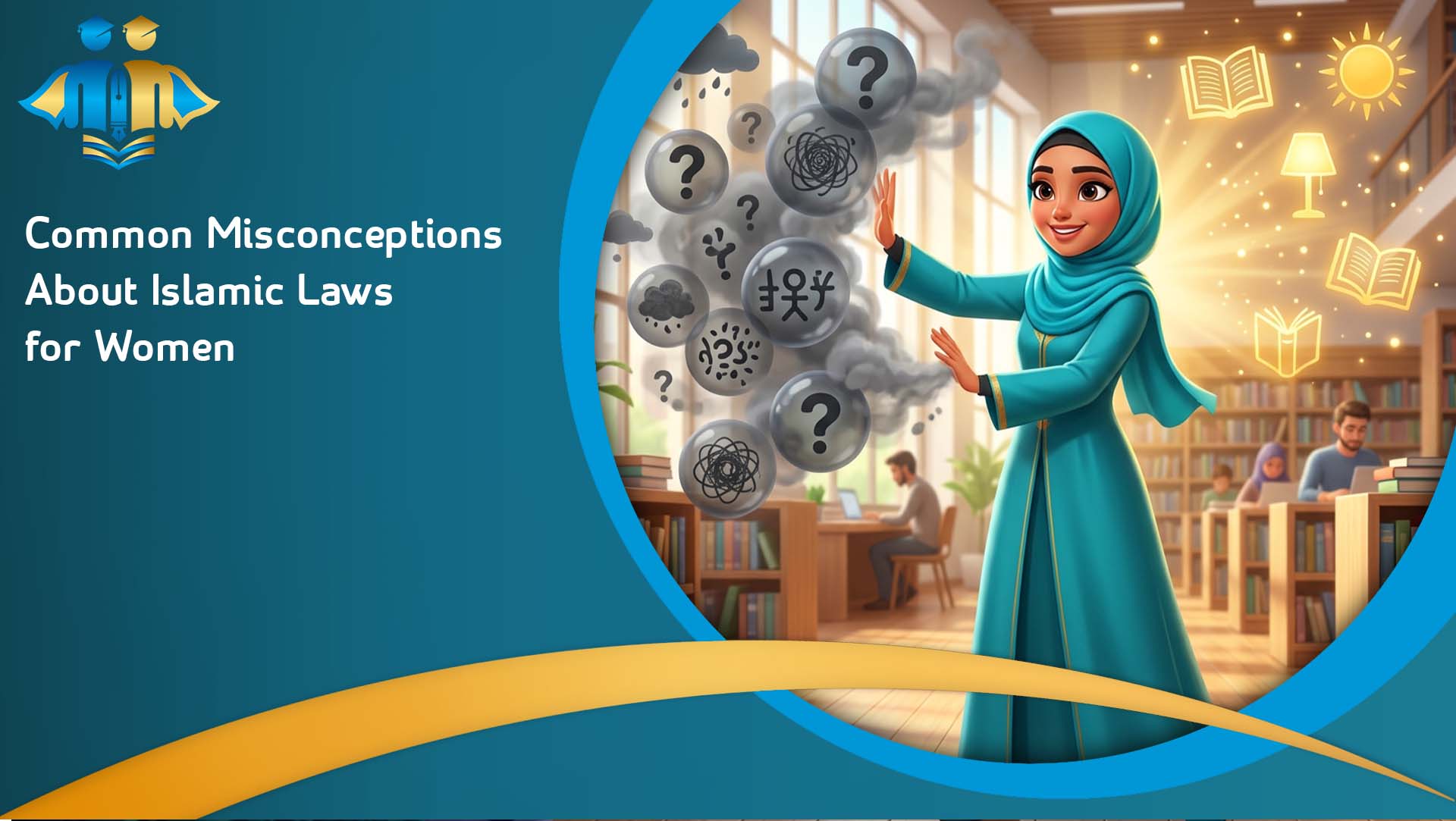
Many online discussions about Islamic Laws for Women combine authentic religious teachings with cultural practices. As a result, readers may encounter claims that sound Islamic but do not accurately represent Islamic jurisprudence.
One common misconception is that Muslim women have no financial independence. Islamic sources clearly recognize women’s ownership of wealth and inheritance.
Another misconception is that women are forbidden from seeking education. Islamic history includes women who taught and transmitted knowledge.
A further misunderstanding concerns inheritance. The statement that every woman receives exactly half of every man’s inheritance does not accurately describe the complete Islamic inheritance system.
Religious Rulings and Cultural Practices
Islamic Laws for Women should be separated from cultural traditions that developed in particular regions.
A custom may be widespread among Muslims without being a universal religious requirement. Likewise, two Muslim communities may apply the same general Islamic principle differently because of differences in jurisprudence, local law, or culture. Therefore, anyone studying Islamic teachings should ask:
- What does the Quran say?
- What authentic Sunnah evidence is relevant?
- Is there a recognized scholarly disagreement?
- Is the practice religious, cultural, or both?
- Does the ruling apply universally or only under specific circumstances?
These questions encourage a more careful approach to Islamic learning.
What Is Not Allowed for Women in Islam?
Many people searching for Islamic Laws for Women want to understand which actions are prohibited for Muslim women. These rulings should be explained carefully because some online sources mix Islamic teachings with cultural traditions or present specific rulings without their proper context.
Many prohibitions in Islam apply to both men and women, including theft, adultery, deliberate injustice, false testimony, and consuming substances that Islam prohibits. Therefore, it is important not to assume that every prohibition discussed in relation to women is exclusive to women.
Islamic jurisprudence also includes rulings that relate specifically to women and their circumstances. These may concern matters such as marriage, modesty, worship, menstruation, family responsibilities, and other aspects of daily life. Understanding these rulings requires referring to the Quran, authentic Sunnah, and reliable Islamic scholarship rather than relying on isolated statements found online.
For example, classical Islamic jurisprudence does not permit a Muslim woman to marry a non-Muslim man. At the same time, the legal requirements and procedures for marriage can vary between countries. For this reason, Islamic Laws for Women should be studied by distinguishing between religious rulings and the civil laws or cultural practices of a particular society.
How Can Women Learn Islamic Laws Correctly?
Because Islamic Laws for Women cover many subjects, learning them from isolated social-media posts can create confusion. A structured approach can make the material easier to understand.
Students can begin with the Quran and authentic Sunnah, then study introductory Islamic jurisprudence with qualified teachers. A useful learning plan may include:
- Quranic verses concerning women and family life.
- Authentic hadith related to women’s worship and rights.
- Basic fiqh of purification and prayer.
- Marriage and family jurisprudence.
- Financial rights and inheritance.
- Islamic manners and modesty.
- Differences between major schools of jurisprudence.
For learners who prefer online education, Super Muslim Online Quran Academy can be part of a structured learning routine that combines Quran study with Islamic education. Students who are balancing work and Quran learning may also benefit from a structured Quran Memorization Schedule for Working Adults when organizing their study time.
The most important goal is not simply memorizing lists of permitted and prohibited actions. Instead, students should develop an understanding of evidence, context, scholarly interpretation, and the principles behind Islamic rulings.
Why Context Matters When Studying Islamic Laws for Women
A single Islamic ruling can sometimes be misunderstood when removed from its context. Marriage, inheritance, divorce, custody, modesty, and financial responsibilities all involve conditions that can change the applicable ruling. For this reason, Islamic Laws for Women should be studied with attention to the circumstances surrounding each issue.
For example, an inheritance ruling depends on the surviving relatives. A divorce ruling can depend on how the separation occurs. A marriage ruling can depend on the faith of the spouses and the conditions of the marriage.
This contextual approach also prevents readers from treating every statement found online as a universal rule.
A Practical Approach to Islamic Learning
When researching a question about Islamic Laws for Women, consider following these steps:
- Identify the exact question rather than searching for a general answer.
- Check the Quranic evidence when applicable.
- Look for authentic hadith.
- Determine whether scholars have different opinions.
- Distinguish religious rulings from local customs.
- Ask a qualified scholar about complicated personal circumstances.
- Avoid websites that provide dramatic claims without evidence.
This approach can make Islamic learning more accurate and less confusing. It can also be especially useful for someone who has recently embraced Islam and is learning the basics gradually. A structured New Muslim Revert Guide: First Steps in Islam can help new Muslims understand where to begin without becoming overwhelmed by too many subjects at once.
For learners considering online Quran education, understanding what happens during an introductory lesson can also be helpful. A guide to What to Expect From a Free Online Quran Trial Class can explain what learners may encounter before starting a regular study routine.
Studying Islamic Laws for Women With Super Muslim Online Quran Academy
For learners who want to study Islamic subjects online, Super Muslim Online Quran Academy can offer a convenient setting for structured learning. Online study can be particularly useful for students who need flexible scheduling or who prefer learning from home.
A structured program may help learners move beyond isolated questions and develop a broader understanding of Quranic and Islamic teachings.
Students researching Islamic Laws for Women may benefit from studying related subjects together, such as Quran interpretation, Islamic manners, worship, family life, and basic jurisprudence.
At Super Muslim Online Quran Academy, learners can approach Islamic education as an ongoing process rather than treating one article as the final source for every legal question.
This is especially useful for beginners who may encounter conflicting information online. Instead of relying on short social-media posts, students can build their knowledge gradually and ask questions when a topic requires clarification.
For anyone beginning the study of Islamic Laws for Women, a structured learning plan can provide a clearer foundation and make it easier to distinguish essential principles from disputed or context-dependent issues.
A Balanced Understanding of Islamic Laws for Women
A balanced understanding of Islamic Laws for Women begins with the recognition that Islamic teachings cover both rights and responsibilities.
Women have established rights concerning spiritual accountability, property ownership, inheritance, marriage, education, and personal dignity. At the same time, Islam also establishes responsibilities related to worship, family life, modesty, ethical behavior, and other areas.
Not every rule concerning men and women is identical. However, differences in particular legal responsibilities should not automatically be interpreted as statements about human worth. Likewise, cultural practices should not automatically be presented as Islamic law.
Key Points to Remember
- Islamic teachings recognize women as morally and spiritually accountable individuals.
- Women can own and manage lawful property.
- Women have recognized inheritance rights.
- Marriage establishes rights and responsibilities for both spouses.
- Women are encouraged to seek beneficial knowledge.
- Islamic modesty includes both men and women.
- Divorce and marital separation involve specific legal procedures.
- Cultural practices should be distinguished from religious rulings.
- Some Islamic legal questions have recognized scholarly differences.
- Complicated personal cases should be discussed with qualified scholars.
Ultimately, studying Islamic Laws for Women is most beneficial when the learner looks beyond isolated statements and considers the Quran, authentic Sunnah, Islamic jurisprudence, and the circumstances surrounding each ruling.
Frequently Asked Questions About Islamic Laws for Women
The following frequently asked questions about Islamic Laws for Women address common concerns and provide clear, practical answers based on Islamic teachings.
1. Can a Muslim woman perform Hajj without a male relative?
The rules concerning a woman traveling for Hajj without a mahram have been discussed differently by Islamic scholars. Some scholars permit travel when safety is assured and specific conditions are met, while others maintain stricter requirements. Therefore, a woman planning Hajj should consult a qualified scholar regarding the view she follows and the practical circumstances of her journey.
2. Can a Muslim woman become a witness in an Islamic marriage?
The requirements for witnesses in a nikah are discussed in Islamic jurisprudence, and the details vary among schools of law. Because witness requirements can affect the validity of a marriage contract, couples should follow the guidance of a qualified scholar or recognized Islamic authority rather than relying on a general internet statement.
3. Can a Muslim woman refuse a marriage proposal?
Yes. Consent is an important element of Islamic marriage, and a woman should not be forced into a marriage she does not accept. Families may advise and discuss marriage proposals, but coercion should not be treated as a normal substitute for the woman’s consent.
4. Does Islam allow women to visit graves?
Scholars have held different opinions concerning women visiting graves. Some permit it under conditions involving proper conduct and avoidance of prohibited practices, while other scholars have taken a more restrictive position based on particular hadith. Therefore, someone following a specific school or teacher should ask for guidance according to that scholarly approach.
In conclusion, Islamic Laws for Women cover a wide range of subjects, from worship and education to marriage, financial ownership, inheritance, modesty, family responsibilities, and divorce. Understanding these teachings requires more than collecting isolated rules from the internet.
The Quran and Sunnah provide the foundation, while Islamic scholars have developed detailed legal interpretations for different circumstances. Moreover, Muslim societies contain cultural practices that should not automatically be confused with religious requirements.
For learners who want to explore these subjects more systematically, Super Muslim Online Quran Academy can support a structured approach to Quran and Islamic studies. Learning with reliable guidance can help students ask better questions, understand different scholarly opinions, and develop a clearer connection between Islamic principles and everyday life.
Most importantly, Islamic Laws for Women should be studied with accuracy, context, and respect for the Islamic sources. A thoughtful approach allows learners to understand both the rights and responsibilities discussed in Islamic teachings without reducing a complex legal tradition to a list of simplistic claims.

You may also like
Hajj and Umrah Guide for Beginners: Step-by-Step
Janazah Islamic Funeral Guide: A Complete Guide